
3 Surprising Tricks for Energized Mornings and Workspace
This is a contributed post.
If your alarm goes off to the immediate soundtrack of hungry kids and a chorus of unread email pings, you are not alone. For countless active parents, mornings are a frantic battle against the clock. You're fighting groggy wake-ups, navigating cluttered desks, and facing an ever-growing to-do list.
This daily chaos can leave you feeling drained and reactive before your workday has even officially begun. But what if there was a way to reclaim those precious early hours? A research-informed, 15-minute ritual can systematically flip that chaos into calm, productive momentum, all without adding more stress.

The Science of a Winning Morning
Transforming your morning isn't about willpower; it's about biology. By understanding and working with your body's natural rhythms, you can create a routine that feels effortless and energizing. Here are the three core scientific principles that power an effective morning ritual.
1. Cortisol Rhythm & Circadian Alerting
Many people reach for coffee the second they open their eyes, but this can actually work against their body's chemistry. Your body has a natural "wake-up" hormone called cortisol, which peaks about 30-45 minutes after you wake up. According to research, levels are high on waking, surge an average of 50–60% in the 30–40 minutes after waking, priming your brain for alertness.
By timing your caffeine intake to coincide with the post-peak dip, you get a smoother, more sustained energy boost. This strategy means you are working with your circadian rhythm, not fighting against it for better results.
2. Light Exposure & a BDNF Bump
Your brain thrives on light, and exposing yourself to bright, natural light shortly after waking sends a powerful signal to your internal clock. This simple action helps regulate your sleep-wake cycle for the day ahead. When combined with light physical movement, it also elevates a crucial protein called brain-derived neurotrophic factor (BDNF).
BDNF is like fertilizer for your brain cells, supporting mood regulation, memory, and learning. A few minutes of stretching by a window can literally make your brain work better and set a positive tone for the hours to come.
3. “Same Time, Same Place” Habit Wiring
The key to making a morning routine stick is to make it automatic. Repeating a specific sequence of actions in the identical context strengthens the dopamine-based neural loops in your brain. When you perform the same ritual at the same desk every morning, your brain begins to associate that place and time with focus.
Eventually, the habit becomes so ingrained that it feels automatic, requiring less mental energy to initiate. By dialing in these biological levers, your morning can become the most predictable and empowering part of a very unpredictable parenting day.
Key Insight: An effective morning routine isn't about willpower; it's about biology. By aligning with your body's natural cortisol rhythms, light exposure needs, and habit loops, you can build effortless and predictable daily focus.
Pillar A: Brew Better Energy
The centerpiece of many morning routines is a cup of coffee, but not all brews are created equal. The quality, timing, and hydration surrounding your coffee can make the difference between sustained focus and a brief, jittery buzz.
Why a Quality Dark Roast Matters
When you're looking for a dependable morning partner, the character of your coffee is key. A thoughtfully roasted coffee can provide a smoother, richer flavor profile that makes your morning ritual feel like a genuine indulgence. For example, some small-batch beans, like Bones Coffee Company's single-serve dark roast coffee, offer a complex flavor that stands on its own.
While it's a common myth that light roasts have significantly more caffeine, dark roasts contain only marginally less. The true advantage is that a richer, less bitter flavor makes controlled dosing easier, so you enjoy the taste without needing extra additives.
Evidence-Based Dosing & Timing
To get the most out of your coffee, precision is more important than volume. Follow these guidelines from sports nutrition and cognitive science to optimize your intake:
Optimal Dose: Aim for a dose of 3–5 milligrams of caffeine per kilogram of body weight for peak performance. For a 150 lb (68 kg) person, this translates to roughly 200-340 mg of caffeine, or about two standard cups of coffee.
Strategic Timing: Consume your coffee 30–45 minutes before a workout or your first deep-work block of the day. This timing allows the caffeine to reach peak levels in your bloodstream right when you need to be sharpest.
Pair with Water: For every mug of coffee, drink 250–500 ml of water. Even mild morning dehydration can slow reaction time, so replenishing fluids is non-negotiable for cognitive function.
Hydration Hacks That Amplify Your Brew
Supercharge your morning hydration with a couple of simple tricks. First, consider dropping a pinch of electrolyte powder into your first glass of water to help your body absorb it more efficiently.
Second, adapt to the seasons by sipping your coffee hot in the winter and preparing a cold brew overnight in the summer.
Caffeine Cut-Off Rules That Protect Your Sleep
Great mornings start the night before. Caffeine has a half-life of about six hours, meaning half the amount you consumed is still in your system hours later. To prevent it from interfering with deep sleep, stop all caffeine intake 8–10 hours before bedtime.
Studies show that evening caffeine consumption delays the human circadian melatonin rhythm. Further research confirms that late caffeine consumption reduced total sleep time by 45 minutes and sleep efficiency by 7%.


Important: A great morning starts the night before. With a six-hour half-life, caffeine can disrupt sleep long after you drink it. Stop all intake 8–10 hours before bed to protect the deep rest your body needs.
Pillar B: Build a Focused Workspace
Your physical environment is a powerful, often overlooked, tool for productivity. A well-designed workspace doesn't just organize your gear; it organizes your mind and primes you for focus before you even sit down.
Desk Mat Anatomy: Built-In Habit Zones
A quality desk mat is more than just a comfortable surface; it's a strategic tool for building focus. A larger mat defines your workspace, creating a clear boundary between work and clutter. The real power, however, comes from using it to create consistent visual cues for your routine.
For instance, a surface like a Custom Envy's heat-resistant custom desk mat can be personalized with visual guides for organization. You can create designated zones for your daily priorities notebook or add a small icon to remind you to stretch, elevating your workspace into a motivational tool.
Distraction-Resistant Setup Checklist
Create a sanctuary of focus by methodically eliminating common distractions. A few minutes of setup can save you hours of fragmented attention later.
Tidy Your Cables. Use an under-desk tray or simple adhesive clips to wrangle cords. Visual clutter creates mental clutter.
Assign a "Single-Task" Zone. Your laptop or primary monitor should occupy a dedicated space. Make it a rule that your phone is not allowed in this zone.
Mount a Headphone Hook. Keep your noise-canceling headphones within arm's reach for immediate access to a focused soundscape.
Keep a "Top 3" Notebook Open. A slim notebook open to today’s three most important goals serves as a constant, non-digital reminder of your priorities.
Automate Your Digital Launch. Set your computer to auto-open essential apps and pin key project documents to the taskbar. This slashes the cognitive cost of starting your day.
Environmental Design as a Habit Cue
This is where the magic happens. When your brain consistently experiences the same sensory triggers in the same context, it builds a powerful habit loop. As your nose catches a rich aroma and your eyes land on the organized layout of your desk, your brain connects the cue to the routine.
It begins to anticipate the reward, which is the satisfaction from task completion. Over time, this conditioning becomes so strong that you'll find yourself sitting down and starting work without the usual internal debate or procrastination.
Key Insight: Your desk isn't just for organizing gear; it's for organizing your mind. By creating consistent sensory cues, your workspace becomes a powerful trigger that automatically signals your brain it's time for focused work.
The 15-Minute Morning Ritual
This simple, repeatable sequence combines hydration, movement, and focus-priming into a powerful 15-minute block. This ritual is designed to set a productive and positive tone for your entire day.
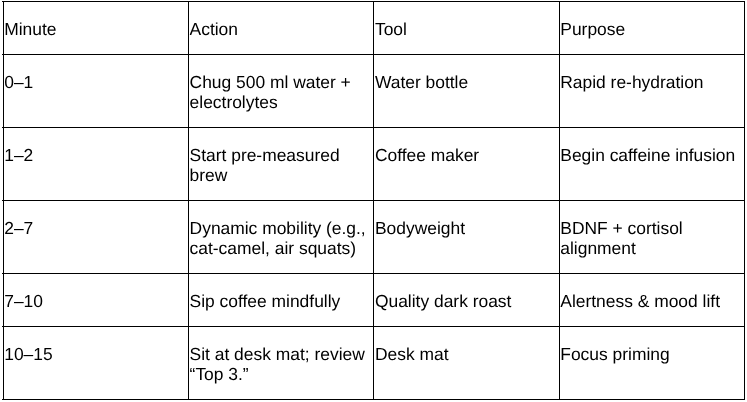
Pro Tip: Set your grinder and pre-measure coffee beans the night before, so all you have to do is press “start.” The fewer decisions you have to make when you're groggy, the better your routine will stick.
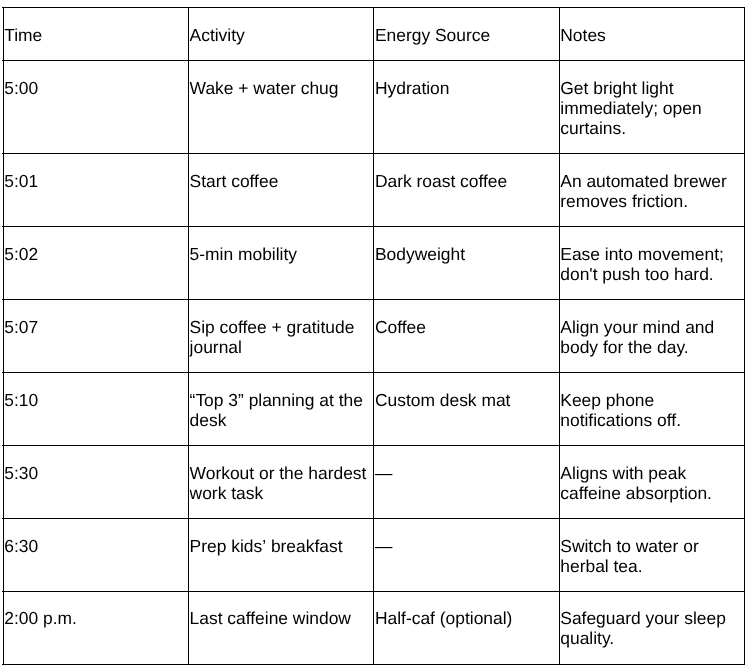
Sample Schedule for Parents (5 a.m.–9 a.m)
Here’s how this ritual can fit into a busy parent’s morning. Use this as a template and adjust the times to fit your family’s unique schedule and daily needs.
Fuel & Digital Hygiene Extras
Beyond your main ritual, these small adjustments can further stabilize your energy and protect your focus throughout the day.
Prioritize Protein and Carbs: Grab about 20 grams of protein and some complex carbs within an hour of waking. This helps stabilize your blood glucose levels, preventing a mid-morning energy crash.
Delay Digital Dopamine: Avoid checking social media or non-critical emails for the first 30 minutes of your day. Easy dopamine spikes from notifications can make it harder to focus on challenging tasks later.
Evening Prep & Sleep Safeguards
A successful morning is won the night before. A simple 10-minute evening routine removes friction and protects the sleep quality you need to wake up energized.
Pre-measure coffee beans and water. Remove one more decision from your morning brain.
Lay out workout clothes and kids’ outfits. Eliminate the morning scramble and decision fatigue.
Write tomorrow’s “Top 3” on a sticky note. Place it on your desk mat so your priorities are the first thing you see.
Dim lights after 8 p.m. Enable blue-light filters on your devices to support your body's natural melatonin production.
Keep the bedroom cool and dark. A temperature around 65 °F (18 °C) is optimal for melatonin release and deep sleep.
Workspace & Ritual Master Checklist
Print this and post it near your desk as a daily reminder. This helps you maintain your high-performance environment with minimal effort.
☐ Cables hidden
☐ Headphones docked
☐ Water bottle filled
☐ “Top 3” sticky note placed
☐ Computer notifications off
☐ Coffee dose prepped (night before)
☐ Custom mat wiped clean
☐ Last caffeine logged
☐ Stretch reminder visible
☐ Gratitude journal within reach
Your Next Steps
Knowledge is only potential power; action is real power. Here’s how to put this guide to work for you starting today.
Try the 7-Day Challenge: Commit to following the 15-minute ritual every morning for one full week. At the end of each day, log your mood and note how many of your "Top 3" tasks you completed.
Iterate and Personalize: Use your data from the challenge to make adjustments. This is your ritual; optimize it for your life and your specific goals.
Share Your Wins: Your progress can inspire other busy parents to reclaim their mornings, too. Small changes can create significant momentum.
Related:
