

Architect Reviewing a Building Model and Architectural Plans
A missing clinical note or an approval that never reaches the imaging center can disrupt scheduled care. For orthopedic practice managers, outsourcing prior authorization only helps when the service clearly defines who checks the records, who follows up with the payer and who notifies the facility.
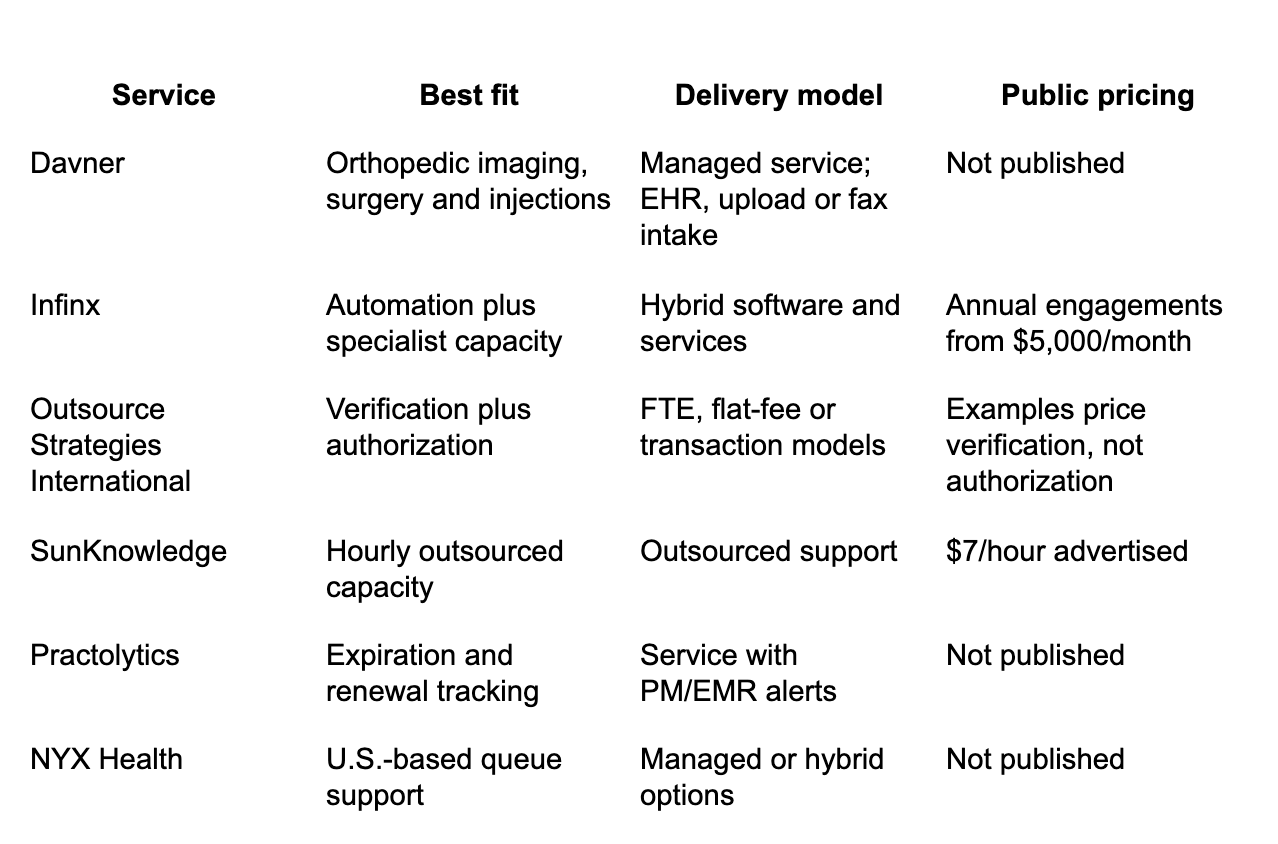
The six services below take different approaches, from focused orthopedic support to hourly capacity and hybrid automation. Each entry covers what the service handles, what stays with your staff and how pricing works.
Key Takeaways
Focused orthopedic services with pre-submission record checks suit practices whose requests stall on documentation gaps.
Hybrid automation-and-specialist models let larger groups route only complex cases to outside help.
Hourly and per-transaction prices don't reveal the cost per completed authorization, so ask for a scoped quote.
Expiration tracking matters when treatment runs past an approved window.
An approved authorization doesn't guarantee payment, so keep claims and authorization responsibilities separate in the contract.
How We Picked
We reviewed each provider's public service pages and documentation as of November 2, 2026, and assessed seven criteria: orthopedic procedure support, documentation checks, submission and follow-up ownership, status visibility and approval handoff, appeal and peer-to-peer responsibilities, system compatibility and pricing clarity.
Keep related functions distinct when comparing vendors. Eligibility verification confirms coverage and benefits, authorization obtains a payer decision for a service, and claim-denial management handles rejected claims. CMS has set January 1, 2027 as the milestone for certain regulated payers to support electronic prior authorization interfaces, but that doesn't mean universal connectivity across commercial plans, so confirm your payers, EHR configuration and service hours with every finalist.
1. Davner
Best fit: Orthopedic, spine and pain practices wanting a managed authorization workflow.
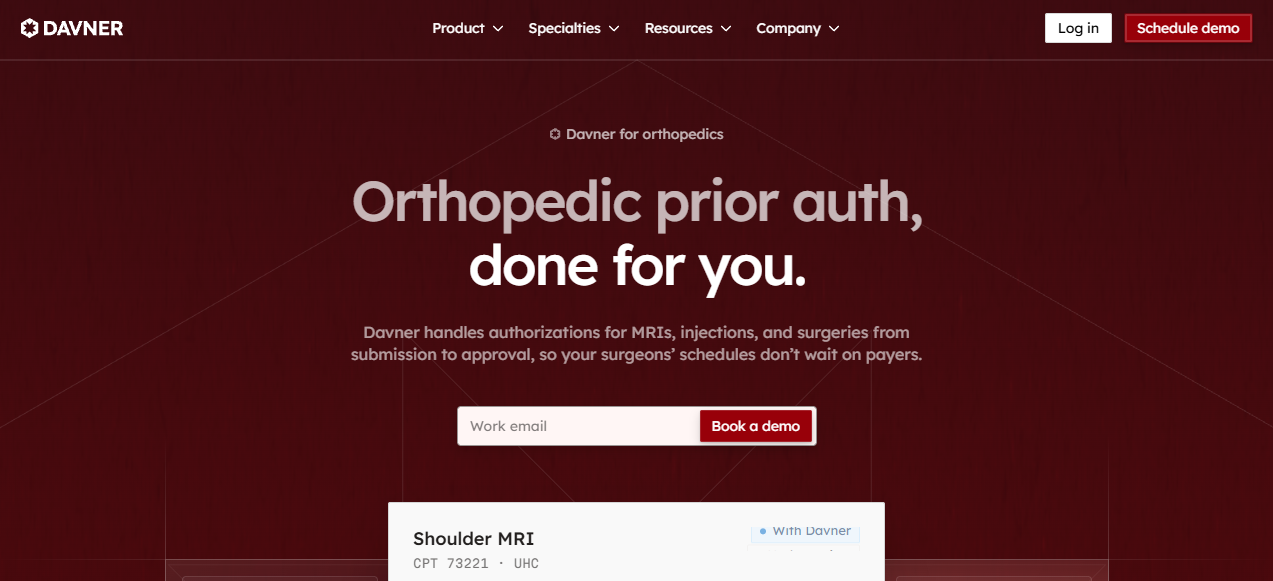
What it covers: Davner handles authorization for advanced imaging, joint replacement, spine surgery, arthroscopy and injections. It checks clinical notes against each payer's criteria, flags gaps before submission, submits by portal, fax, phone or clearinghouse, and follows up until there's a decision, sending results back to the providers and facility.
Pros:
Flags documentation gaps, such as missing conservative-care dates, before submission
Prioritizes approaching service dates and automatically appeals invalid denials
Accepts cases by EHR, secure upload or fax, with HIPAA and SOC 2 compliance
Cons:
Staff upload records and verify the details it fills in
The practice arranges peer-to-peer reviews
Pricing: Not published. Request a quote scoped to your imaging, surgery and injection volume.
2. Infinx
Best fit: Orthopedic groups wanting automation with access to external specialists.
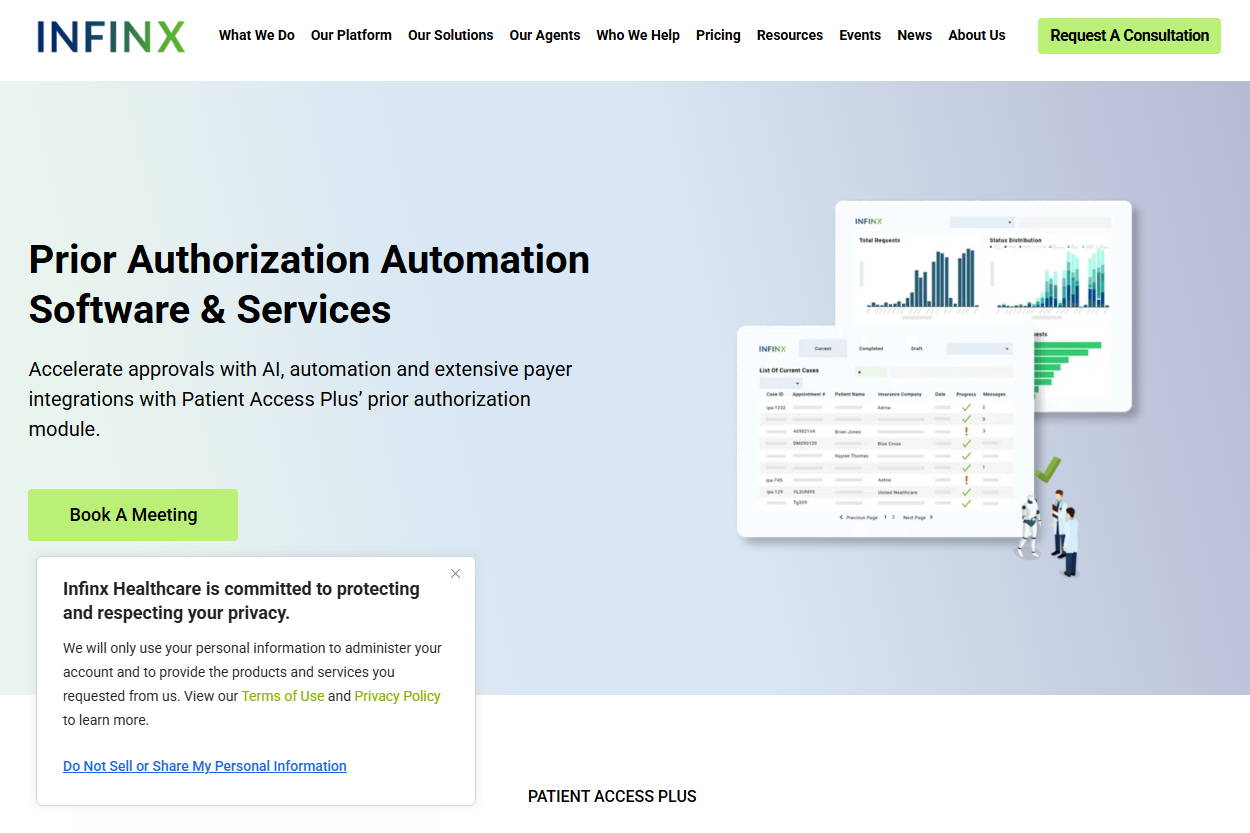
What it covers: Infinx determines whether authorization is needed, initiates requests electronically, follows up with payers and updates the EMR. Specialists handle cases requiring manual work, and a hybrid arrangement lets practices assign a defined subset of cases. Orthopedics appears on its supported-specialty list.
Pros:
Clear hybrid model for routine and complex requests
Repeated payer follow-up and EMR updates
API or HL7 connectivity, subject to system checks
Cons:
The staff-specialist split needs case-specific scoping
The engagement starting point may not suit a small queue
Pricing: Annual engagements start at $5,000 per month. Ask for a written scope covering specialist capacity, implementation and any per-request charges.
3. Outsource Strategies International
Best fit: Practices wanting coordinated benefits verification and authorization.
What it covers: OSI's orthopedic page connects eligibility and benefits checks with authorization requests, using live payer calls and portal checks. It includes submissions, follow-up, appeals and billing-system updates, with a dedicated manager for project communication.
Pros:
Combines verification and authorization in one scope
Works within existing workflows and systems
States service in all 50 states with no long-term contracts
Cons:
Published price examples cover verification, not authorization
EHR compatibility and escalation ownership need a sales conversation
Pricing: FTE, flat-fee and transaction models. Its examples, starting at $500 per month for verifications and $5.00 per eligibility request, don't set an authorization price, so request an orthopedic-specific quote.
4. SunKnowledge
Best fit: Practices evaluating hourly capacity, including orthotics and prosthetics work.
What it covers: SunKnowledge describes insurance checks, authorization initiation, documentation review and payer follow-up, including Medicare teams. It lists orthotics and prosthetics, pain management, physical therapy and radiology among its specialties.
Pros:
Hourly model suits practices with a supervisor directing outside work
Includes coding-related support alongside request preparation
Covers orthotics and prosthetics, where Medicare added orthoses codes to prior authorization from October 28, 2026
Cons:
An hourly rate doesn't show cost per completed authorization
Minimum hours, EHR access and surgery coverage need confirming
Pricing: An April 6, 2026 article advertises a $7 hourly service charge. Confirm minimum hours, included tasks and how long the rate holds.
5. Practolytics
Best fit: Practices linking authorization tracking with broader revenue cycle support.
What it covers: Practolytics coordinates documentation gaps with the clinical team, monitors pending cases and follows up with payers. Its FAQ names orthopedics as a supported specialty and describes PM/EMR expiration alerts with renewal initiated before expiry.
Pros:
Expiration alerts help when treatment runs past an approved window
Status visibility for open requests
States plainly that authorization doesn't guarantee payment
Cons:
No numeric authorization price published
Authorization-only versus broader revenue cycle scope needs clarifying
Pricing: Not published. Cost depends on volume, specialty complexity, payer mix, scope and follow-up, so ask for a written quotation.
6. NYX Health
Best fit: Practices wanting U.S.-based help with a defined queue or staffing gap.
What it covers: NYX Health describes U.S.-based teams working within existing EHR and payer systems, covering eligibility, documentation, submissions, follow-up, resubmissions and appeals. It names orthopedics among supported specialties and offers managed service, standalone automation or automation with specialists.
Pros:
Flexible delivery models for fluctuating workloads
Medical and prescription authorization support
Dashboard covering status, volume, denials and appeals
Cons:
No numeric price published
Orthopedic payer coverage and the automation-specialist split need confirming
Pricing: Not published. Its free workflow assessment is a sales step, so ask the proposal to separate supplemental coverage from fully managed work.
How to Choose the Right Service for Your Practice
Start with where your authorizations stall. If requests bounce back for missing exam findings or conservative-care dates, prioritize a service that checks records against payer criteria before submitting. If the problem is volume, compare capacity models, from hourly support to hybrid automation, and ask how each handles surges around surgery schedules.
Surgical requests usually face the strictest review. By the time a patient is ready to consider knee replacement surgery, payers typically want imaging, documented conservative treatment and functional limitation in the chart. A delayed or incomplete request can push that surgery back, so documentation quality matters as much as speed.
Then compare responsibilities, not just price. For each finalist, confirm who checks documentation, who contacts payers, who handles denials, who arranges peer-to-peer reviews and who notifies the surgical facility once a decision arrives.
Conclusion
The best prior authorization partner depends on why your requests stall and how much work you want to keep in-house. Focused orthopedic services suit practices losing time to documentation gaps, hybrid and hourly models suit groups with internal supervisors, and renewal tracking matters for longer treatment plans. Send every finalist the same de-identified scope, including request volume, procedure mix, payers, state, EHR configuration and service hours, and require itemized quotes with a written responsibility list before handing over your queue.
FAQ
What orthopedic procedures usually need prior authorization?
Advanced imaging, joint replacement, spine surgery, arthroscopy and interventional pain procedures commonly require it, though rules vary by payer and plan.
Does an approved prior authorization guarantee payment?
No. Authorization confirms the payer approved the service, but claims can still be denied for other reasons, such as coding or eligibility issues.
Is hourly pricing cheaper than a managed service?
Not necessarily. An hourly rate doesn't show the cost per completed authorization, so compare quotes built on the same case mix and responsibilities.
Who handles peer-to-peer reviews?
It varies. Some vendors supply the denial reason and a justification while the practice arranges the call, so confirm this in writing.
