
Expert Strategies Builders Follow to Create Personalized Homes for Modern Living
Settling for a house that almost works is one of the more expensive mistakes a person can make. Walk through enough new developments, and you start noticing the same awkward hallways, the same pointless formal dining rooms, the same closets that couldn't fit a real wardrobe.
There's a reason personalized home building has shifted from a luxury conversation to a mainstream expectation, and the numbers back that up. Hippo surveyed more than 2,000 U.S. homeowners and found that 90% considered flexible spaces very or moderately important when selecting a new home. That's not a niche preference. That's the market speaking.
The Core Principles Behind Truly Personalized Modern Home Building
Here's something most buyers don't realize: expert home builders don't open with floor plans. They open with questions.
Lifestyle Mapping Comes Before Modern Home Design
Before a single sketch exists, the best builders invest serious time understanding how your household actually operates. Morning routines. Work-from-home schedules. The hobbies that need real square footage. The long-term goals, aging parents, growing kids, a home studio that isn't an afterthought.
That information drives every zoning decision afterward. Which spaces need acoustic separation? Where does the indoor-outdoor connection make genuine daily sense? Should that spare room function as a guest suite now and a private office later? Builders who skip this step end up designing for a hypothetical family. Builders who don't skip it design for you.
Geography matters here, too. Colorado Springs builders work with mountain views, high altitude, and dramatic seasonal swings as everyday realities, not scenic backdrops. Window orientation, outdoor living design, and thermal performance all read differently when Pikes Peak is part of your commute.
Personalization Has to Respect Budget and Long-Term Value
Lifestyle mapping is only useful if the insights survive contact with a real budget. Skilled builders help you sort wishes into three categories: non-negotiables, nice-to-haves, and phase-two upgrades. The smartest early investment almost always goes into infrastructure, conduit runs, electrical capacity, and structural framing, rather than ultra-specific finishes that may feel dated in eight years.
You can always swap out the tile. You can't easily rewire a finished wall.
Building for Flexibility Means Building for the Next Decade, Not Just Today
Families shift. Remote work became permanent for millions of people almost overnight. Multigenerational living arrangements are rising steadily. Smart builders factor that unpredictability into design through convertible loft spaces, modular room configurations, and basements prepped structurally but left unfinished for later. Pre-wired infrastructure is one of the most underrated decisions you can make during initial construction. It costs relatively little upfront and saves enormous disruption later.
Advanced Custom Home Builder Strategies That Turn Vision Into Reality
Good principles establish the foundation. These strategies are what actually build the house.
Focused Collaboration Sessions With Architects and Designers
Decision fatigue is real. Vague briefs produce vague results. Short, structured design sprints, bringing architects, interior designers, and clients together around specific decisions, move projects forward faster and with far more clarity.
Builders who run these sessions consistently report fewer change orders and cleaner outcomes. Mood boards and Pinterest saves are useful raw material, but the goal is translating that inspiration into a coherent modern home design direction everyone can commit to.
Layered Lighting Is the Detail Most Buyers Underestimate
Once the layout is locked, atmosphere becomes the priority, and nothing shapes atmosphere more quietly than lighting. Expert builders layer ambient, task, accent, and circadian-appropriate lighting into programmable smart systems tied to real daily rhythms.
Morning routines, focused work sessions, dinner settings, late-night wind-downs, each scene reflects how the household actually lives. Not how a model home photographs.
Storage Infrastructure Should Match the Way You Actually Use Your Home
A home can be beautifully designed and still feel chaotic if the storage doesn't align with real life. Thoughtful home customization ideas go beyond square footage calculations, sports gear rooms, built-in closet systems, hobby spaces designed around specific collections, and under-stair solutions that earn their footprint. This is where the function stops being an afterthought and starts being the point.
Digital Tools That Make Personalization Concrete Before Construction Starts
Seeing your decisions before they're permanent changes everything. The anxiety that normally accompanies major design choices drops significantly when you've already walked through the space virtually.
3D Modeling and Virtual Walkthroughs Remove Costly Guesswork
Leading builders now offer full virtual walkthroughs before construction even begins. That means layout issues can be spotted early, before they turn into costly problems. You can see how spaces connect, adjust views, and feel more confident in your choices. It also helps avoid second-guessing later on.
More builders are starting to use these tools, making the process clearer and more collaborative. It’s worth asking your builder about their digital workflow. It’s not just about tech; it shows how well your ideas and preferences will be understood and carried through every step of the build.
A Practical Planning Checklist for Your First Builder Conversation
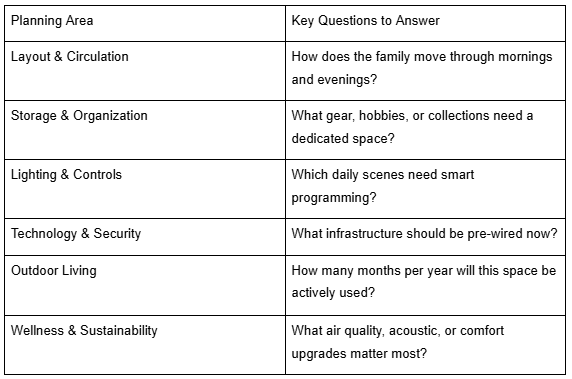
Bring completed answers to this table to your first meeting. It immediately shifts the conversation from vague exploration to productive decision-making.
Final Thought
The custom home builder strategies outlined here, lifestyle mapping, layered lighting, smart infrastructure, and flexible design, aren't isolated tactics. They reinforce each other. When they work together, the result is a personalized home for modern living that performs well every single day, not just on move-in day.
Start with honest answers about how you actually live. Bring those answers to your builder. The clearer your picture, the better every decision that follows, and the more your finished home will feel like it was genuinely built for you.
Common Questions About Personalized Home Building
1. How do I prepare for my first meeting with a custom home builder?
Bring a lifestyle audit, daily routines, hobbies, storage needs, and five-year plans. Behavioral details give builders far more useful starting material than inspiration images alone.
2. Which personalizations offer the strongest return on investment?
Layout, lighting infrastructure, and mechanical systems consistently deliver the highest returns. They're harder to change later and directly affect daily comfort, energy costs, and resale value.
3. How do I avoid my personalized home feeling dated in five years?
Focus on function and infrastructure over trend-driven finishes. Flexible rooms, neutral architectural bones, and adaptable smart-home platforms age far better than style choices tied to a single moment.
4. Can semi-custom homes match the personalization of a fully custom build?
Semi-custom offers meaningful choices in finishes and some layout elements, but structural and mechanical flexibility is genuinely limited. A full custom build gives you real control from the foundation up.
5. What's the smartest way to phase upgrades without disrupting finished spaces?
Pre-wire and prep during initial construction. Conduit runs, structural blocking, and unfinished basements allow phased upgrades to slot in cleanly, no tearing into finished walls, no household disruption.
Related:
