
First Steps for Albuquerque Families After a Suspected Wrongful Death
Grief and paperwork arrive together. One week you are planning a funeral; the next you realize that video may already be overwritten, accounts are changing hands, and a legal deadline is quietly running. If you have been searching for information on how to file a wrongful death lawsuit in Albuquerque, set aside the larger case for now. The immediate job is narrower: preserve records and figure out who can act.
A death that arrives out of the blue is not, by itself, a wrongful death. What matters is whether wrongful conduct caused the death in circumstances that would have supported a claim had the person survived, such as negligent medical treatment. That determination takes time. While it happens, your job is simply to keep the evidence intact.
How to file a wrongful death lawsuit in Albuquerque: start with authority and timing
Confirm who can file in New Mexico
Under NMSA 1978, Section 41-2-3, a New Mexico wrongful-death action must be brought in the name of the deceased person's court-appointed personal representative. A spouse or adult child does not ordinarily file on their own as an individual. In Stang v. Hertz Corp., the New Mexico Supreme Court describes the representative as a trustee for statutory beneficiaries, which helps illustrate the role.
To understand how personal representatives work in a wrongful death case, first separate who may file from who receives proceeds. Being appointed does not, by itself, make the representative the recipient of all proceeds. Bring any existing appointment order to your consultation.
Write down who holds the estate documents, and note whether anyone has already opened a court proceeding. If relatives disagree about who should act, raise that issue early. And do not assume the oldest child has authority.
Put wrongful death claim deadlines in Albuquerque on the family calendar
NMSA 1978, Section 41-2-2 generally requires a wrongful-death action to be filed within three years of death. Three years sounds generous. It is not a guaranteed window. If a public entity may be involved, notice requirements can run on a much shorter clock, and probate complications or disputed dates demand prompt attention.
Ask counsel to identify the earliest date that requires action. If correspondence gives a response date, bring the entire notice so counsel can tell that date apart from the lawsuit's filing deadline.
Families often get stuck on two questions: who can file, and by when. Resources on how to file a wrongful death lawsuit in Albuquerque become useful when you map those two questions against New Mexico's notice rules and probate status, turning a general three-year rule into a dated action plan for your specific circumstances before you send a single records request.
What evidence to preserve after a wrongful death
Secure records that explain what happened
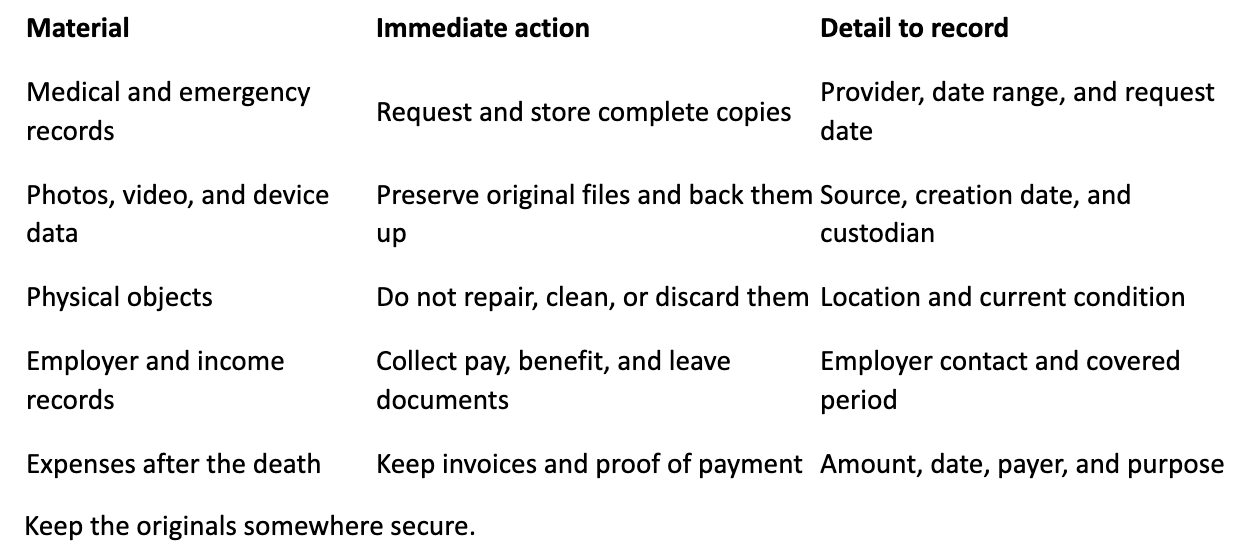
Keep original medical records and bills, death certificates, and autopsy documents. Keep incident reports, photographs, and video. Save messages, work records, and insurance correspondence. Protect the deceased person's devices and cloud accounts, but do not assume you have legal access; ask the provider or account custodian what authorization it requires.
Do not edit files or write on original documents. Avoid repairing or discarding physical items. Keep theories of fault off social media, and work from copies.
Video gets overwritten. Accounts change after a death. Ask counsel promptly about sending preservation requests to anyone holding relevant material, rather than waiting for a complete medical file.
Create a simple preservation log
Use a basic tracking sheet. Record where each item is held and who controls it, and add request dates so an unanswered records request does not disappear in a crowded inbox.
Document financial losses without guessing at a final value
How damages are documented in a wrongful death claim
Gather funeral and burial invoices along with final medical bills. Add payroll and tax records, employment-benefit statements, and household financial records. Document the services your loved one regularly provided and how often, such as school pickups or weekly grocery trips.
For the damages assessment, Section 41-2-3 can award the deceased person's life value to the estate. That means documenting age, earning capacity, health, habits, and probable duration of life. It is not simply a total of existing estate assets.
Record the covered pay period on each wage document so a one-time bonus is not mistaken for recurring income. If you replace a household service, keep the replacement invoice and note what the deceased person previously did.
Not every recorded expense will be recoverable. Keep estimates separate from paid bills, and note who paid each charge. If a relative covered the funeral deposit, preserve that receipt too.
When the family situation is not straightforward
What happens if there is no will?
The absence of a will does not prevent an action. Rule 1-017(B) NMRA permits a petition to appoint the wrongful-death personal representative before the lawsuit or together with it. Ask counsel how that appointment relates to any separate probate proceeding. Handling someone's bills does not give you authority to pursue litigation, so bring any existing court orders.
What if several people or organizations may be responsible?
Do not choose a theory prematurely. A driver and an employer might both need examination, or a medical event might involve several providers. These are illustrations, not findings of liability. Build one chronology that identifies each participant and event, and connect each entry to the relevant communication or document.
Label approximate times rather than assigning an exact minute. Leave a gap when a fact is unknown. Ask counsel how to request evidence instead of approaching suspected parties for informal statements.
What if liability is uncertain?
Uncertainty is common early on. The question under Section 41-2-1 is whether evidence connects actionable conduct to the death. Label what you saw personally, and separate it from what someone told you. Mark assumptions as assumptions, with the source and date beside each entry.
Practical answers about proof, cost, and taxes
How hard is it to establish a wrongful-death claim?
Section 41-2-1 requires a causal link to wrongful conduct. Difficulty depends on the evidence supporting that link, along with recognized damages and a proper plaintiff. Conflicting accounts or missing medical records can require further investigation, including an expert review of the treatment record.
What are common legal grounds for wrongful death?
Section 41-2-1 covers a death caused by a wrongful act, neglect, or default that would have supported an action had the person lived. Negligent driving and unsafe premises are possible grounds. Deficient medical care is another. Each requires evidence connecting the conduct to the death.
What are the odds of winning?
No single statewide percentage can predict a particular case's outcome. Results depend on admissible evidence and causation under Section 41-2-1, and defenses and procedural compliance matter too. Insurance coverage or available assets can affect what you can collect, even after a favorable judgment.
Who pays the costs of bringing the case?
Your written attorney-client agreement should explain who pays what. Ask who advances filing fees and what happens to deposition and expert costs if there is no recovery. Legal fees and expense reimbursement are separate questions, so make sure the agreement addresses both.
Is money from a wrongful-death case taxable?
Do not assume the entire recovery is tax-free. The IRS's settlement and judgment tax guidance explains that federal treatment depends on what a payment represents; physical-injury damages may be treated differently from punitive damages or interest. Ask a tax adviser to review the written allocation.
A manageable next move
You don't need to settle liability questions while managing the first days of grief. Keep records unchanged and identify who can act to protect your options while you seek guidance specific to your circumstances. Pick one manageable task today: place the death certificate and any will or estate papers in a secure folder, then add your preservation log and deadline notes beside the chronology and expense file.
