
How I Use IQ Quizzes to Keep Myself Motivated to Grow - My Honest Take on IQCenter.com
I've always liked the idea of measuring myself against, well, myself. Not against other people, not against some abstract standard of "smart" - just a way to check in periodically and ask: am I sharper than I was a few months ago? Am I still putting in the mental reps? IQ quizzes scratch that itch in a way almost nothing else does, and IQCenter.com has become my go-to for it, not because I think it's handing me a clinical verdict on my intelligence, but because it gives me a small, recurring nudge to keep showing up for my own brain.
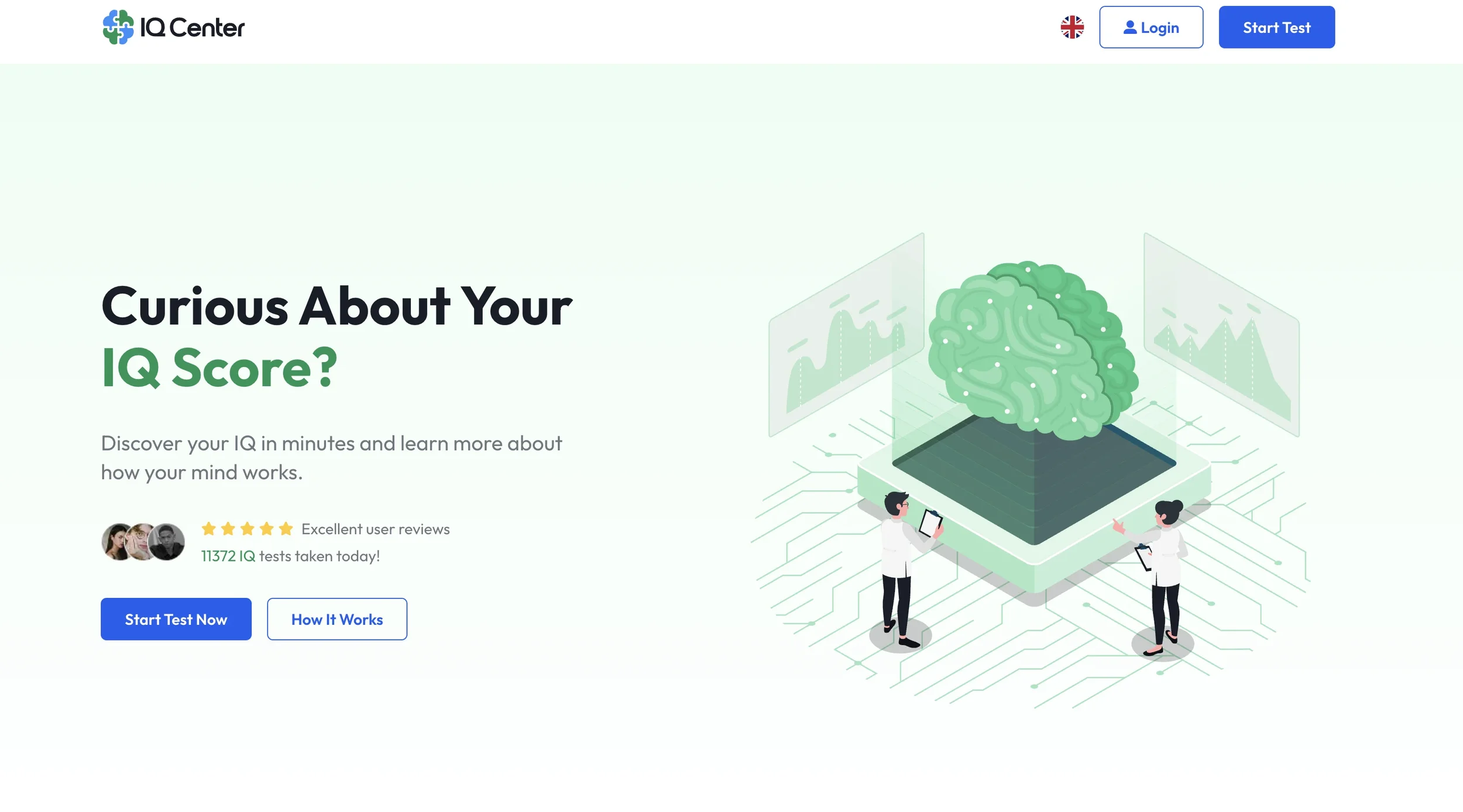
My personal feedback of the app: 4.9/5 — for context, that lines up with the platform's own public review scores (4.7 among reviews on Reviews.io, 4.6 on Trustpilot), which is unusually strong for this category. Most comparable quiz sites land well below that.
Why I Started Doing This in the First Place
A while back I noticed I was spending a lot of mental energy on autopilot - scrolling, half-reading, half-thinking. I wanted something that would force actual focused reasoning for a few minutes, on a regular basis, without needing to enroll in a course or commit to a huge routine. IQ-style puzzles turned out to be perfect for that. Pattern completion, rotation and sequence problems, abstract analogies - none of it requires background knowledge, just sitting still and actually thinking for a stretch. That's the whole appeal for me: a short, structured burst of real mental effort, on demand.
What Actually Keeps Me Coming Back
The thing that surprised me about IQCenter is how much it's built like a habit-forming app rather than a one-off quiz page. There's a whole ecosystem behind the login - a "brain workout" home screen, a library of puzzle games, a separate section of short courses, and the tests themselves organized into categories. That structure matters more for motivation than I expected it to. It's the difference between "I guess I'll take another IQ test someday" and "there's a lobby that resurfaces something new every time I open the app."
The retest cadence is part of what keeps me motivated too. I don't take the same test daily - that would be pointless repetition, not growth - but coming back every so often and watching a trend line rather than a single, isolated number is what makes this feel like development rather than a party trick. One score is trivia. A string of scores over months, alongside deliberate effort in between, starts to feel like actual data about my own consistency.
I'll be honest about the test itself, too, since motivation only holds up if the experience underneath it is decent: the puzzles genuinely make you think. They escalate from simple grid patterns to more abstract, multi-rule problems by the end, and I never felt like I was being tricked by a cheap gotcha question. The advertised "five minutes" is wildly optimistic - my careful runs take closer to fifteen or twenty minutes - but if you're setting aside real focus time rather than a coffee-break glance, that's not really a downside.
The Part of My Motivation That's About Mindset, Not the Score
Here's where I want to be honest with myself, and with anyone reading this: the number at the end is not a medical fact. IQCenter says as much directly in its own terms - it describes itself as an entertainment product and is explicit that its scores aren't a validated measure of intelligence or any clinical characteristic. I don't find that discouraging. If anything, it's freeing. It means I get to use the number as a personal motivator rather than a verdict. I'm not chasing a diagnosis; I'm chasing a habit of sitting down and actually reasoning through hard patterns on a regular basis. The score is just a scoreboard for that habit, not a label for who I am.
That distinction matters even more with some of the other tests on the platform - there are ADHD, Autism, and BPD-style quizzes sitting right alongside the IQ and personality tests. I've looked at a couple of them purely out of curiosity, but I'm careful to treat them the same way: as light self-reflection prompts, not anything resembling a real screening tool. The platform's own fine print is upfront that none of this is a substitute for an actual professional, and I think that's the right way to hold all of it - useful for a nudge of self-awareness, not a substitute for real evaluation if something's genuinely concerning me.
The Games and Courses Have Become Part of the Routine Too
What keeps this from feeling like a chore is that IQCenter isn't just the tests. There's a genuine library of casual puzzle games - block puzzles, word searches, number games - that I'll open on a slow evening instead of another test, and a set of short courses on things like personal development and emotional intelligence that scratch a similar itch without needing another quiz score at the end. It's turned into a broader little habit loop: some days it's a retest, some days it's a puzzle game, some days it's a lesson from one of the courses. The variety is honestly what's kept me returning consistently rather than losing interest after the novelty of the first test wore off.
My Actual Takeaway
I don't use IQ Center because I think it's telling me something scientifically rigorous about my intelligence. I use it because it's an easy, low-stakes way to build a habit of deliberate thinking, watch my own consistency over time, and stay a little more engaged with my own mental sharpness than I would be otherwise. The trend line matters more to me than any single score, and the games and courses have made the whole thing feel less like a test I'm taking and more like a small corner of my routine I actually enjoy showing up for.
If you're looking for a clinical measurement of your intelligence, this isn't that, and it says so itself. But if you're looking for a low-effort, genuinely engaging way to nudge yourself toward a little more regular mental exercise - and you're comfortable holding the results loosely, as a personal motivator rather than a fact about yourself - I've found it to be a pretty solid part of my own routine.
