
7 Ways to Improve Resident Satisfaction in Senior Living Communities
Avoidable move-outs cost more than a useful resident survey program. Effective tools reach residents, flag problems, and alert the right manager while issues are fixable.
I compared seven platforms used by U.S. senior living operators, focusing on collection methods, service recovery, recognition, reporting, security, and pricing. Activated Insights is my overall pick.
How I tested these senior living survey platforms
Collection options. I favored platforms combining email and text with staff-assisted tablets, paper, or phone interviews, giving residents with different abilities a fair chance to respond.
Individual follow-up. Aggregate scores show trends but cannot resolve a resident's concern. I looked for alerts and identifiable feedback supporting direct service recovery.
Industry alignment. I considered CoreQ and U.S. News Best Senior Living recognition. Florida's upcoming CoreQ-related requirements make vendor status relevant there.
Security, benchmarks, and pricing. I reviewed stated healthcare security credentials, benchmarks, reporting tools, and pricing. Every company here uses custom or quote-based pricing.
1. Activated Insights
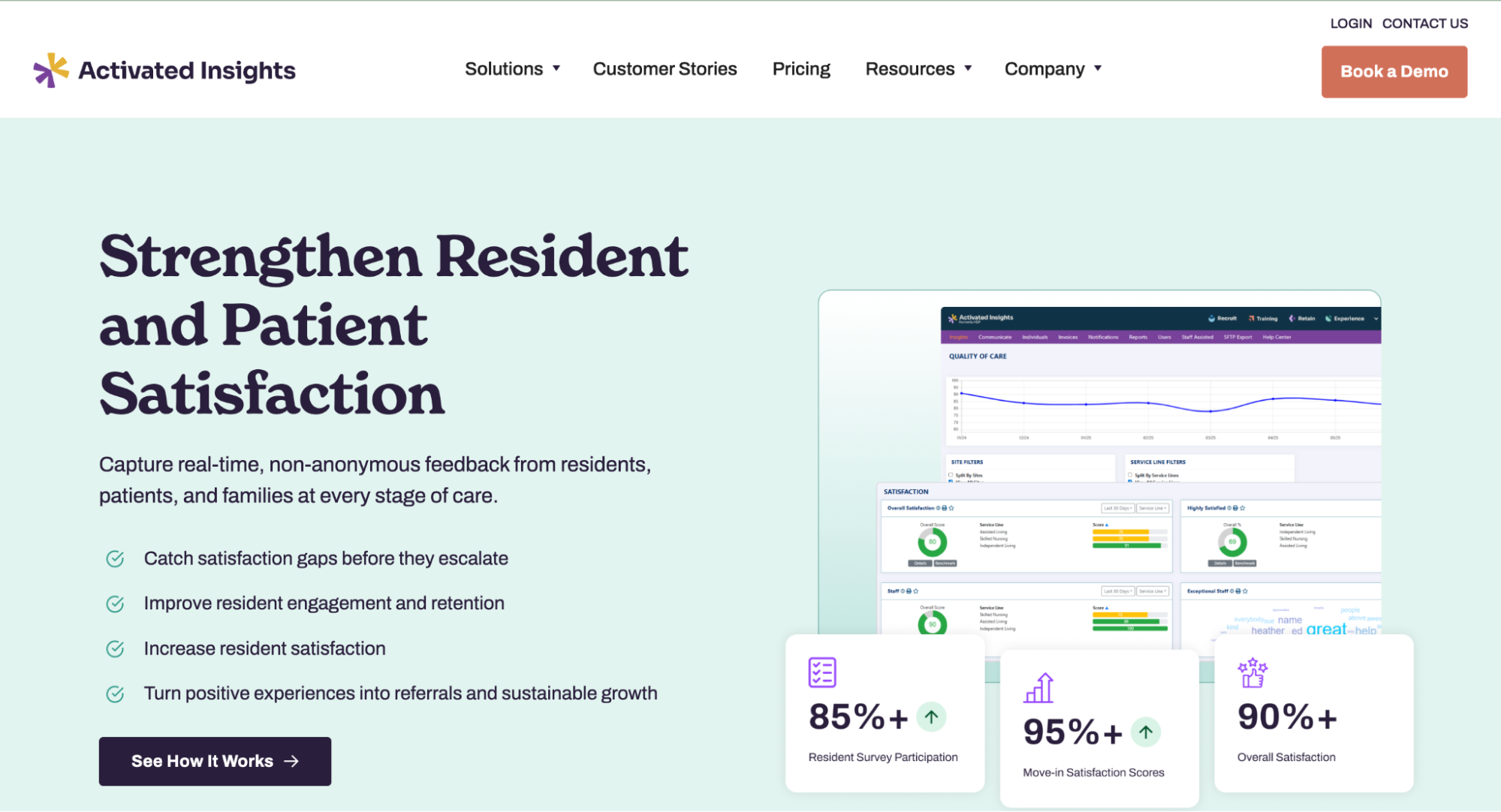
Activated Insights pros
Certified CoreQ vendor and CMS-approved survey vendor
Real-time alerts help managers respond to feedback quickly
Responses are tied to residents for direct service recovery
Email, SMS, staff-assisted tablets, and live phone interviews
New-resident checks at two weeks and 45 days
Move-out surveys designed for senior living communities
States it is approved for U.S. News Best Senior Living surveys
Imports resident contact lists directly from your EHR
Activated Insights cons
Pricing is not available without requesting a quote
Alerts require local leaders who consistently own follow-up
My experience with Activated Insights
What changed my thinking was seeing an alert arrive while the issue was still fixable. A resident reported a dining concern, and the executive director could address it that afternoon instead of finding it in a quarterly report.
The named response completes that feedback loop. Managers can document what happened, contact the resident, and confirm whether the solution worked. That closed loop matters more for senior living communities than leaving the complaint as an anonymous theme in a dashboard.
In practice, Activated Insights felt purpose-built for gathering non-anonymous, real-time resident feedback without adding unnecessary administration. Staff-assisted tablets and live phone interviews also include residents who may never open an email, and the company reports 80%+ completion rates across its methods.
The two-week, 45-day, and move-out cadence helps teams catch small problems before they contribute to dissatisfaction or a move-out. Best-performing communities on the platform report participation above 85% and overall satisfaction above 90%.
Activated Insights pricing
Pricing is custom and quote-based. Scope will likely depend on portfolio size and the residents or employees covered. During the demo, ask how quickly alerts and lifecycle surveys can launch at your first community.
2. Holleran
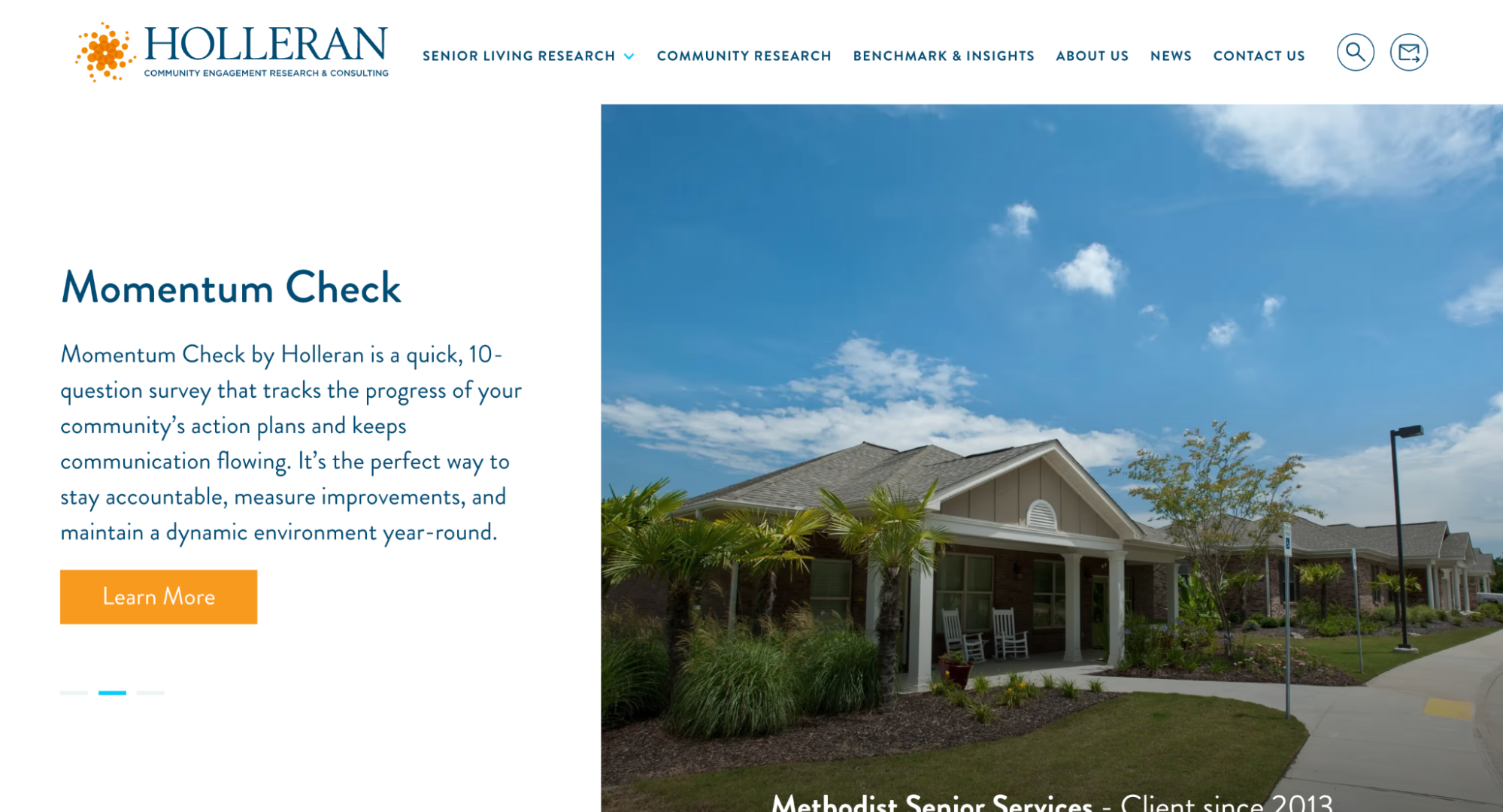
Holleran pros
Provider partner for CoreQ and U.S. News Best Senior Living
Benchmark of more than 200,000 resident and employee surveys from the past three years
Holleran cons
Pricing is not published
Its services-led model requires more vendor involvement
Holleran describes its surveys as anonymous, which limits individual service recovery
My experience with Holleran
I would consider Holleran when the main question is why engagement is slipping. Its research-oriented reporting provides context that can be shared with leadership. EnGauge 365 also reduces reliance on one annual survey by spreading feedback across the year. The trade-off is that Holleran's surveys are designed to be anonymous, so the data supports organisational action rather than following up with a specific resident.
Holleran pricing
Pricing is quote-based and depends on portfolio size, services, and survey frequency.
3. Press Ganey
Press Ganey pros
Validated instruments across healthcare settings
Extensive national benchmarking data
Multiple distribution channels and mature analytics
Suitable for health-system and post-acute networks
Press Ganey cons
Can feel heavy for a single community
Senior living is one part of a broader platform
My experience with Press Ganey
The benchmark depth is the main draw. Regional leaders can compare locations using a consistent dataset. The platform felt more corporate than senior-living-specific, but that structure makes sense for multi-site operators already reporting experience data to a health system.
Press Ganey pricing
Pricing is quote-based and scoped by care settings, locations, and survey volume.
4. Qualtrics XM for Healthcare
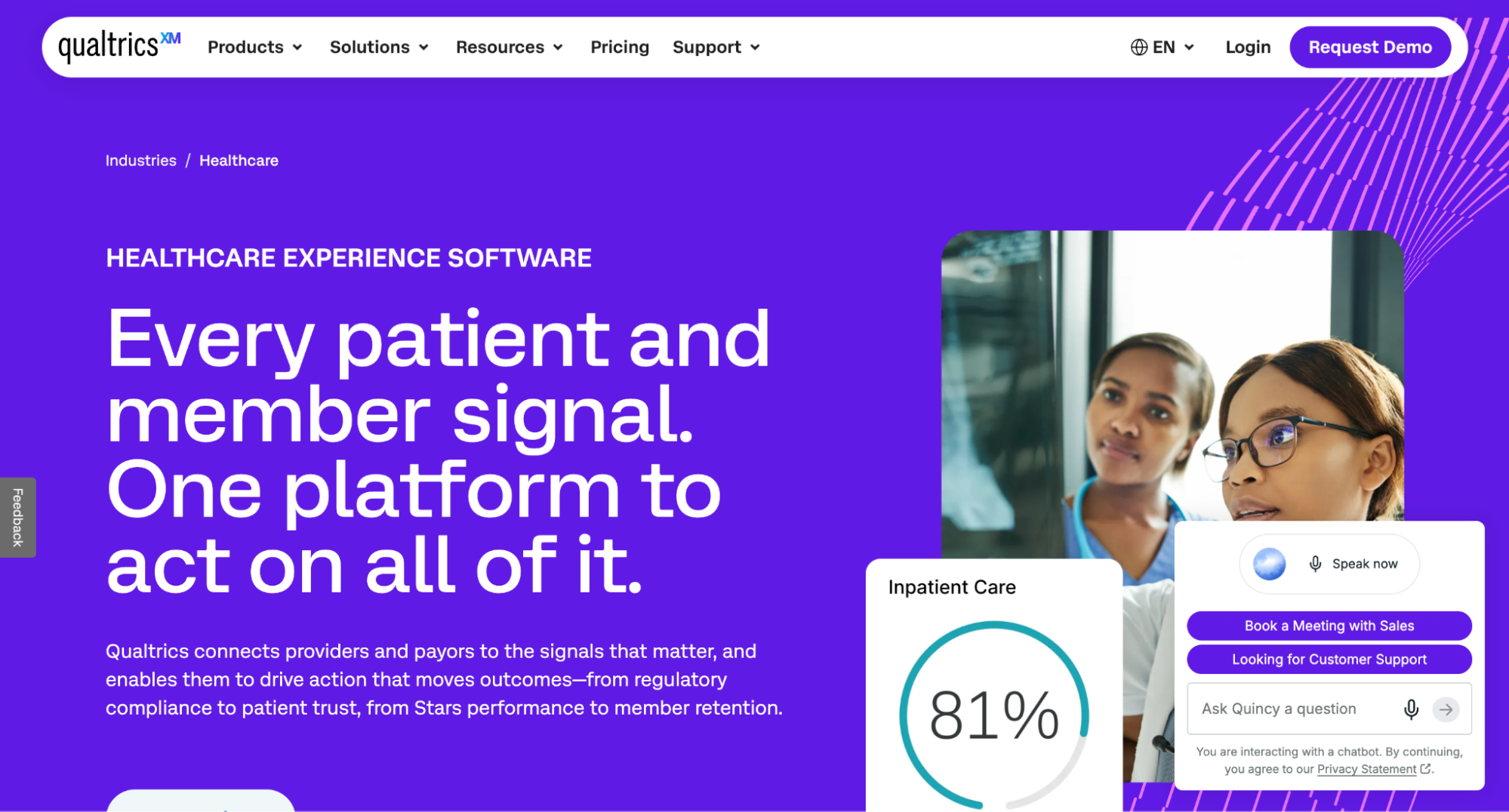
Qualtrics pros
States HIPAA, HITRUST, and FedRAMP coverage
CMS-approved CAHPS vendor
Flexible survey design and text analysis
Qualtrics cons
Requires an internal platform owner
My experience with Qualtrics
Qualtrics makes sense for teams that want to build resident, family, and employee programs themselves. Its flexibility is useful, but senior living workflows must be configured. Without a knowledgeable internal owner, the platform can become an underused license.
Qualtrics pricing
Pricing is customized around program requirements and expected usage. Request a quote using realistic response volumes.
5. Sensight Surveys
Sensight pros
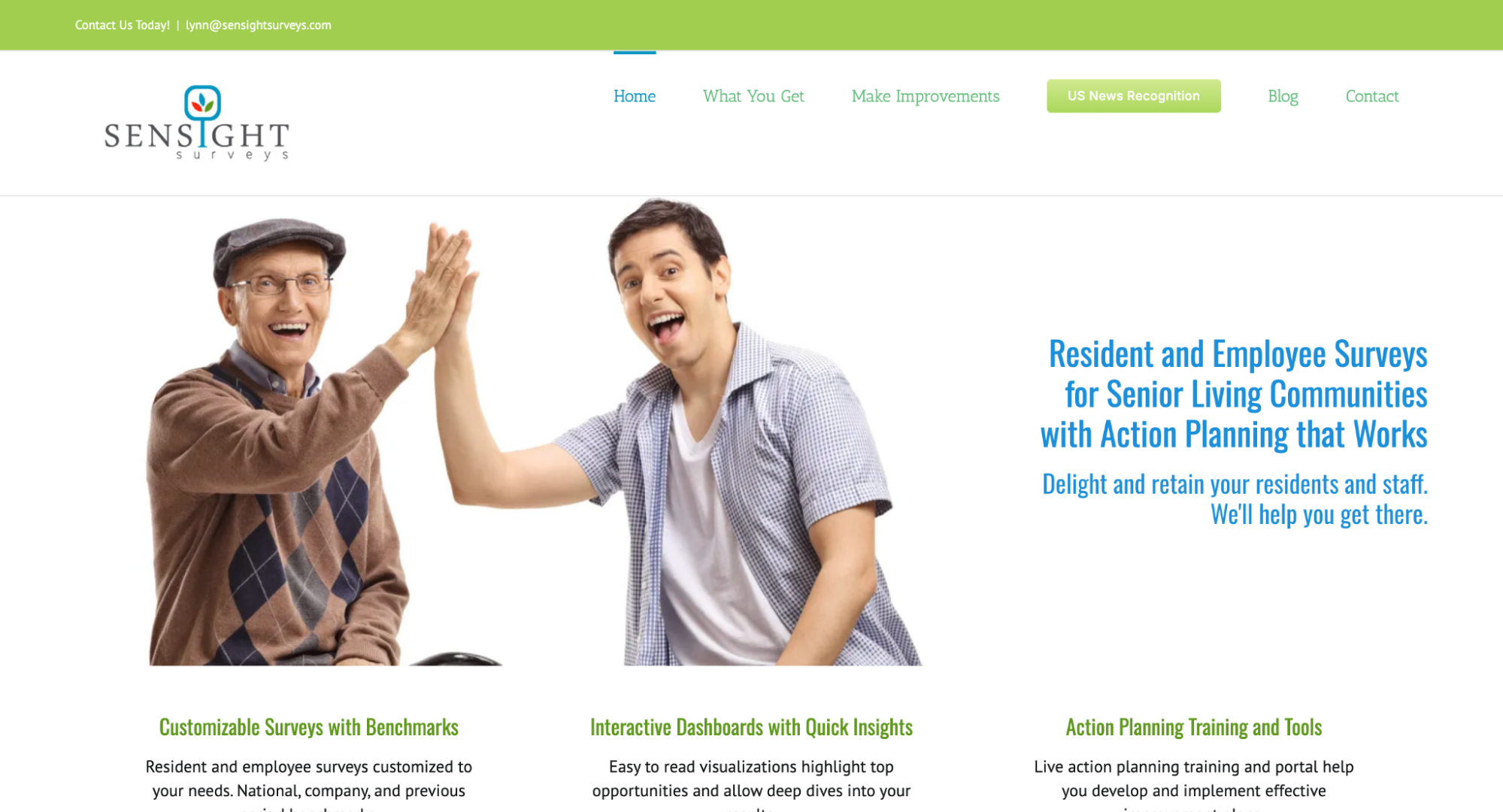
Customizable resident and employee surveys
National and company benchmarks
Action-planning training and tools
Sensight cons
Fewer publicly documented integrations
My experience with Sensight
Sensight felt consultative, especially around action planning. That matters because many operators collect data but struggle to turn it into department-level commitments.
Its combination of digital and paper surveys is also practical for communities serving residents with varied needs, from independent living through memory care, where an early dementia diagnosis changes both how you reach a resident and which family caregivers answer on their behalf.
Sensight pricing
Sensight uses custom, quote-based pricing.
6. ResidentRated
ResidentRated pros
Move-in, move-out, and comprehensive surveys
Automatic survey generation
Real-time access to results
ResidentRated cons
Limited public detail on integrations and security frameworks
My experience with ResidentRated
This is a practical pulse-survey option. Automated move-in and move-out surveys capture two important moments, while fast access to results supports timely fixes. I would pair it with a deeper annual study rather than use it as the only measurement program.
ResidentRated pricing
Plans are package-based, with pricing provided by quote.
7. Care Analytics
Care Analytics pros
Certified CoreQ vendor with AHCA and NCAL
Monthly LTC Trend Tracker uploads once response thresholds are met
Real-time tablet and SMS point-of-care surveys
Care Analytics cons
Narrower senior living feature set than full experience platforms
Trend Tracker inclusion requires at least 20 valid responses per community
My experience with Care Analytics
Care Analytics offers a direct route for operators prioritising CoreQ workflows. It reviews CoreQ data monthly and uploads to LTC Trend Tracker once a community meets the response requirements, which reduces manual work but is not instant. Communities needing lifecycle, family, or highly customised feedback may still require another tool.
Care Analytics pricing
Care Analytics provides custom, quote-based pricing.
Conclusion
Activated Insights is my top pick for most senior living operators. Real-time alerts, resident-level responses, accessible collection methods, and lifecycle surveys give teams a practical way to identify concerns and close the loop. Its stated U.S. News Best Senior Living approval adds value for communities pursuing recognition.
Holleran is a strong runner-up for research-led engagement programs, while Press Ganey suits operators connected to larger healthcare networks. Qualtrics is worth considering when an experienced internal team wants to build custom workflows.
Sensight can help teams turn findings into action plans. ResidentRated works well for event-based pulses, and Care Analytics provides a focused CoreQ workflow. Because every option uses custom pricing, ask vendors to demonstrate what happens during the first 24 hours after a resident reports a concern.
