
How the art on your bedroom walls affects your sleep, stress, and life as a dad
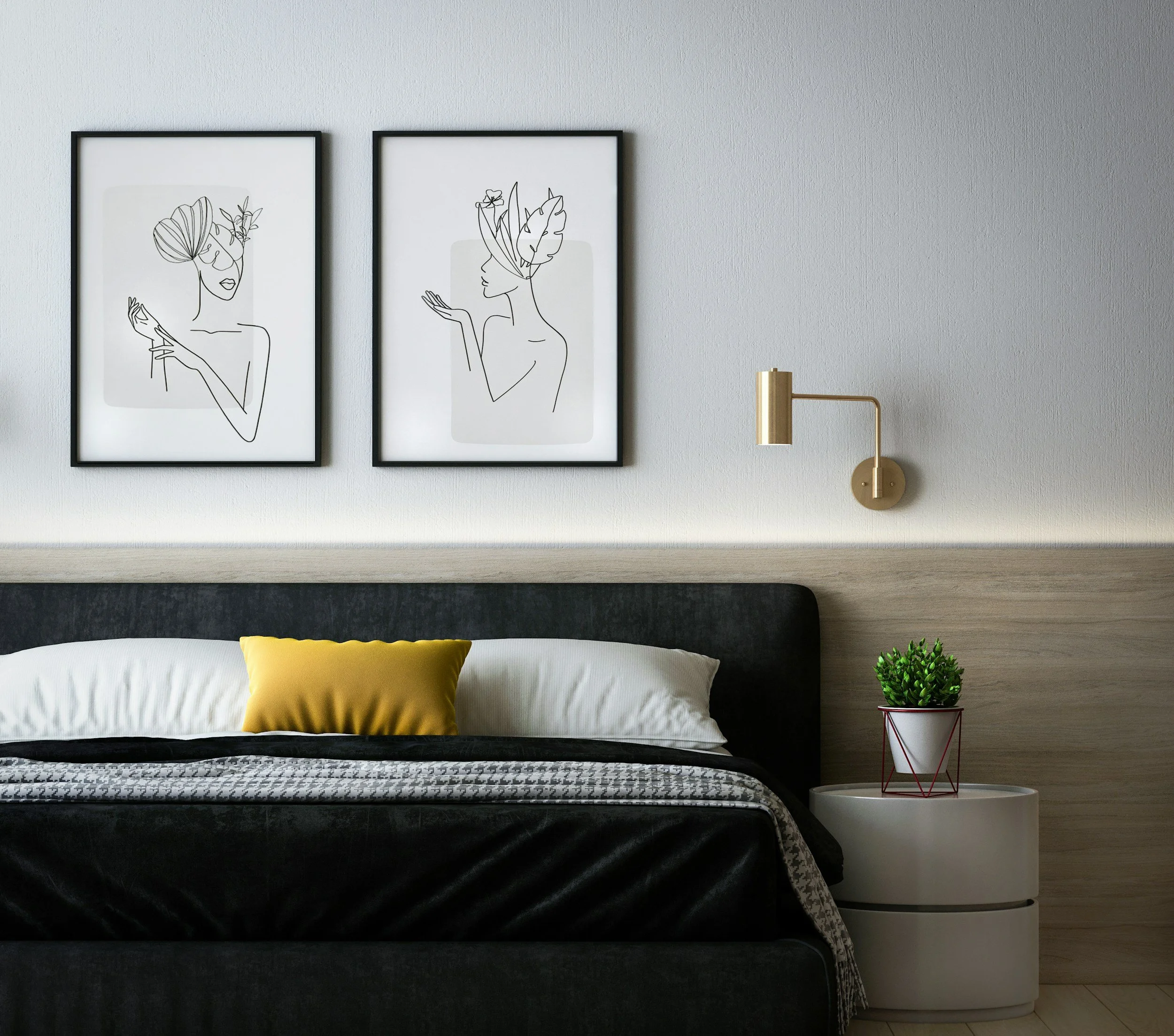
You’ve probably put real effort into your health. Maybe you track your sleep, you’ve dialed in your diet, you’ve got a workout routine that actually sticks. But there’s one room in your house that most dads have never treated as a wellness environment: the bedroom.
Not the gym. Not the kitchen. The bedroom - the place where you spend roughly a third of your life - often ends up as an afterthought. Whatever artwork happened to land on those walls is still there, usually because nobody had a reason to move it.
That’s worth reconsidering. What you look at before you fall asleep and the moment you wake up isn’t neutral. It signals something to your nervous system, and those signals compound over time. This article isn’t about interior design. It’s about a practical, evidence-backed decision that most dads have never thought to make.
Your bedroom is doing more than you think
Your bedroom is your primary recovery environment. Every night, your brain and body use that space to do work that genuinely can’t happen anywhere else - consolidating memory, regulating hormones, processing emotional stress from the day. What that environment looks like, sounds like, and feels like matters more than most of us give it credit for.
Visual clutter raises cortisol. Dim, warm light lowers it. Color affects heart rate. These aren’t soft, fuzzy wellness claims - they’re documented physiological responses. Your nervous system is reading the room whether you want it to or not.
Most dads have never thought to apply this logic specifically to their bedroom walls. The walls are an afterthought, or they’re blank, or there’s something hanging there from 2009 that no one ever actively chose.
That’s where wall pictures for the bedroom come in - not as a decorating exercise, but as a deliberate wellness decision. Choosing what you look at in that space is part of optimizing it, just like keeping the temperature cool or keeping your phone on the other side of the room.
What the science says about art and stress
Here’s what makes this more than just a preference: the research on art and physiological stress response is genuinely compelling.
A 2025 King’s College London study conducted at The Courtauld Gallery found that viewing original artwork reduced cortisol levels by 22% and dropped pro-inflammatory markers IL-6 and TNF-alpha by 30% and 28%, respectively. That’s measurable biological change - not a subjective “I felt calmer.” These are stress biomarkers responding to art exposure, tracked in a controlled study.
A separate peer-reviewed analysis published in 2026 in Applied Psychology: Health and Well-Being (Wiley/IAAP) went further, identifying art viewing as a direct pathway to psychological well-being, with effects on both mental and physical health outcomes across multiple studies. The Wiley/IAAP finding is significant because it aggregates evidence across populations, not just gallery visitors.
The important caveat: both of these studies focused on gallery-setting art exposure. The research on living with art at home is less controlled and harder to measure. But the underlying mechanisms - visual processing, aesthetic response, the nervous system calming in the presence of certain imagery - don’t stop working when you’re in your own bedroom. If anything, repeated daily exposure to calming visual content compounds the effect over time.
Nature-themed imagery shows the strongest consistent results. Landscapes, water, trees, soft organic shapes. These work on the nervous system in ways that abstract or high-contrast imagery doesn’t.
The sleep connection every dad needs to understand
The stress response doesn’t flip off at bedtime. If your bedroom environment is subtly activating your nervous system - through clutter, through visually busy art, through the general sense that the space isn’t designed for rest - that’s working against sleep onset before you’ve even closed your eyes.
The National Sleep Foundation’s 2025 Sleep in America Poll found that nearly 9 in 10 adults with good sleep satisfaction are “flourishing” - defined as being productive at work and home, maintaining strong relationships, and making progress on personal goals. On the flip side, poor sleep satisfaction tracked closely with the opposite. That’s a lot riding on one environment.
For dads specifically, the stakes are even clearer. Sleep-deprived fathers are shorter on patience, slower to regulate their emotions, and less mentally present during the moments that actually matter - dinner, bedtime, the school run. The research is detailed on this: the bedroom environment isn’t separate from your capacity to parent. It’s upstream of it.
Research from Stanford’s Sleep Medicine division, published in 2025, found that sleep quality directly affects emotional regulation and mental health outcomes - particularly for adults carrying ongoing stress loads. There’s a direct line between what happens in your bedroom at night and how you show up the next morning.
A visually chaotic bedroom delays sleep onset. An intentionally calm one supports it. Art is one lever in that system.
Choosing the right art for your bedroom
Not all artworks work the same way in a sleep environment. Content, color, and scale all affect how a piece registers in the brain.
Content is the most important factor. Nature scenes, soft landscapes, and abstract shapes with organic curves tend to calm the nervous system. High-contrast imagery, intense portraiture, and anything with a lot of visual activity do the opposite. If a piece would feel at home in a busy restaurant or a city loft, it probably doesn’t belong above your bed.
Color matters too. Blues, greens, and soft neutrals are associated with lower heart rate and slower breathing. Warm oranges and reds can be grounding in the right context, but high-saturation, bright colors tend to increase arousal. The goal in a sleep environment is to land in a calm, neutral state - not stimulated, not anxious, just settled.
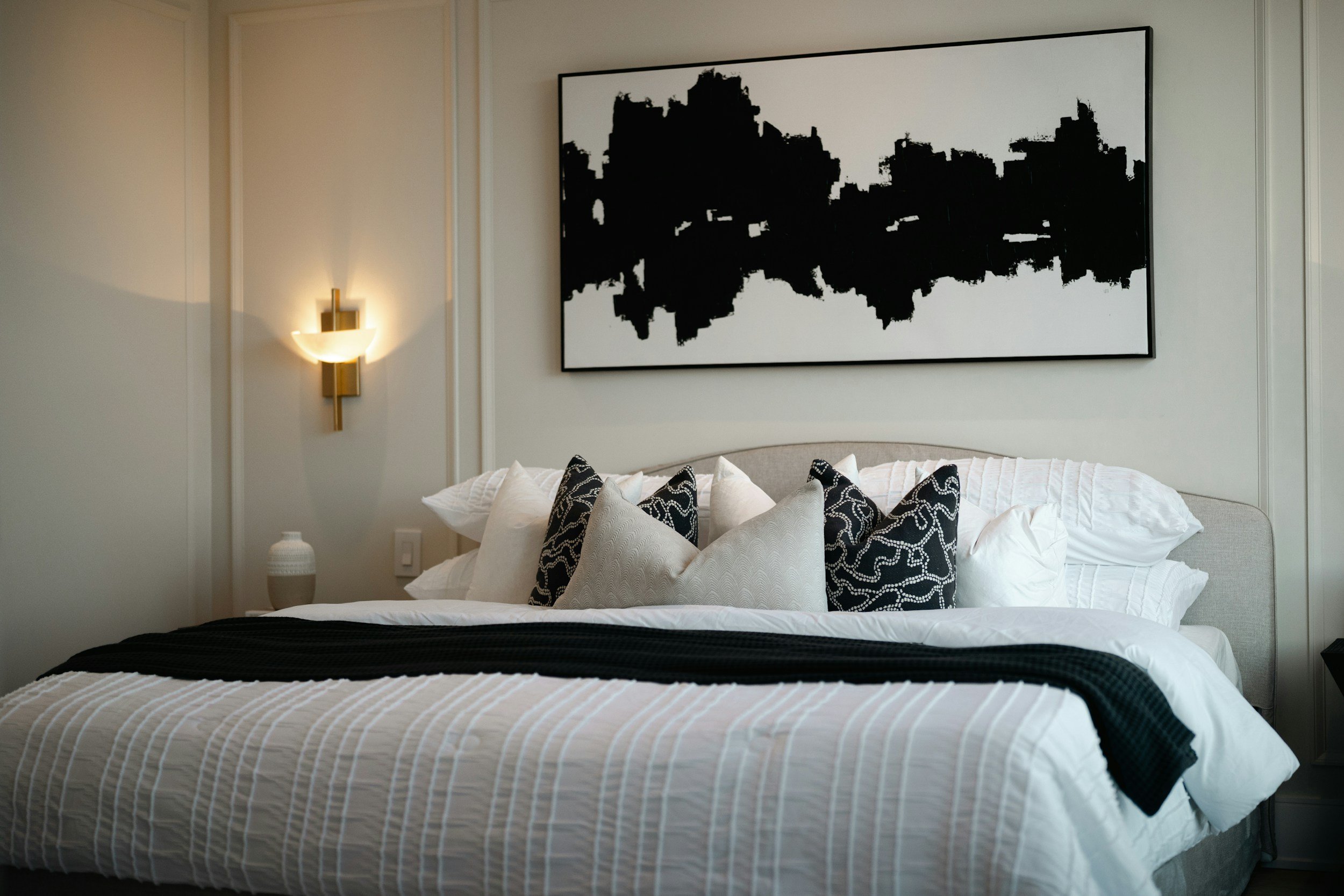
Scale is worth thinking about. One well-chosen piece above the headboard does more psychological work than a gallery wall packed with a dozen frames. Gallery walls are visually busy by design. That’s fine in a living room. In a bedroom, busyness is the enemy of rest.
Personal meaning adds real value. A piece that connects to a place you’ve traveled, something from nature you actually care about, or imagery with a family connection - that personal resonance adds weight beyond the visual. When you see something meaningful, you don’t just process it visually. You feel something, and that matters in a space designed for emotional recovery.
The stress fatherhood puts on you is real and documented. Understanding what fatherhood stress actually looks like - the way it lives in your body and shows up in your mood - makes it easier to take seriously the environments you’re recovering in.
The practical upgrade: where to start without overthinking it
This doesn’t require a full room redesign, a big budget, or a crash course in art history. It requires one decision.
Start with the wall you see first when you wake up. That’s the piece that sets your first visual input of the day. What’s there right now? Is it something that makes you feel anything positive, or is it just filling space? Then look at what’s directly in your field of vision as you fall asleep. Same question.
A 2024 Opendoor report found that Americans spend an average of $1,598 per year on home decor. Most of that goes toward furniture, storage, and functional items. Bedroom art tends to sit at the bottom of the priority list. But if you’re already spending that money on your home environment, redirecting even a small fraction toward something intentional for the one room where you spend eight hours every night is a reasonable reallocation.
Bedroom art is also just one part of a broader picture. If you’re thinking about creating a calmer environment at home, the bedroom is a natural starting point - it’s where your body does its most essential recovery work.
One piece. One wall. One decision that you’ll encounter every single day. You already make deliberate choices to improve your health - your workouts, your sleep schedule, what you eat. This is the same category of decision, just in a part of your life most dads haven’t thought to apply yet.
The upgrade that costs you one decision
The bedroom environment you’ve been sleeping in is already affecting you. The walls, the colors, the visual clutter or lack of it - your nervous system processes all of it every day, and it responds. You just haven’t been making that choice intentionally.
The science of art and stress response is real. The connection between bedroom environment and sleep quality is documented. And the stakes for dads - the emotional regulation, the patience, the capacity to be present - are too high to keep treating your bedroom like an afterthought.
Look at your bedroom walls tonight. Ask one question: is what’s there working for your recovery, or against it? If you don’t know the answer, that’s probably the answer. One well-chosen piece above the bed won’t fix everything, but it’s a genuine upgrade that costs you nothing except the time it takes to decide.
Related:
