
Non 12 Step Rehab Orange County: When the Traditional Model Doesn't Fit

You went to the meetings. You sat through them, you tried to mean the words, and something in the framing kept you at arm's length from the whole thing. Then you felt guilty about that, because everyone told you it was the answer.
People searching for non 12 step rehab orange county programs usually aren't dismissing what works for other people. They're looking for something that fits them well enough to actually engage with, which turns out to matter more than which model is theoretically superior.
What People Are Actually Reacting To
The objections are consistent, and none of them are unreasonable.
The Powerlessness Framing
Admitting powerlessness over the substance is the foundational step, and it lands very differently depending on the person. For some it's an enormous relief, ending years of failed self-management.
For others, particularly people whose sense of agency is central to how they function, it reads as the opposite of what they need. Approaches built on self-efficacy start from the position that you can learn to influence the behavior directly, which some people find far more workable.
The Higher Power Element
Twelve-step programs describe themselves as spiritual rather than religious and allow wide latitude in how a higher power is defined. That latitude genuinely works for many people.
It doesn't for everyone. Atheists, agnostics, and people with difficult religious histories often find the language a persistent obstacle, and spending your energy translating the framework leaves less for the actual work.
One Model for Everyone
Twelve-step programs are remarkably consistent by design, which is part of their strength. Someone can walk into a meeting anywhere in the world and recognize it.
The tradeoff is that a single structure has to serve people with very different histories. Someone with severe social anxiety may find group sharing genuinely difficult. Someone with PTSD may need trauma work before any group setting is tolerable.
What Non 12 Step Programs Use Instead
These approaches are the standard evidence-based toolkit rather than anything exotic.
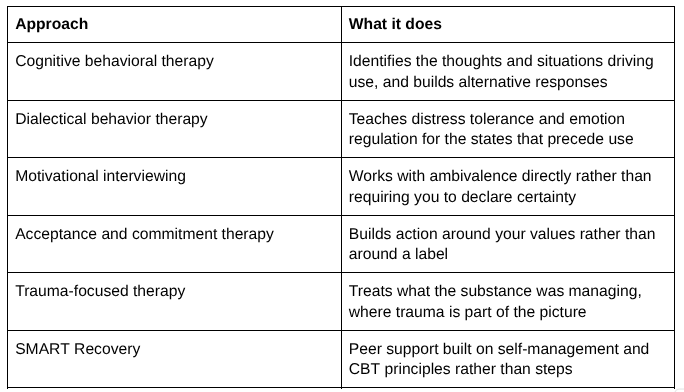
The consistent thread is treating substance use as a learned pattern maintained by identifiable factors, which means the factors can be identified and worked on individually.
Where Medication Fits
This is often the practical dividing line. Some traditional recovery communities remain skeptical of medication-assisted treatment, and people on buprenorphine or methadone occasionally report being told they aren't truly sober.
Programs built around clinical models treat MAT as standard care for opioid use disorder, supported by strong evidence for reducing overdose risk. If you're on medication or considering it, ask directly how a program regards it before admitting.
What the Twelve-Step Model Does Well
An honest comparison has to include this. Twelve-step programs offer something no clinical program can match, which is a free, permanent, worldwide community available every day for as long as you want it.
That structure has supported an enormous number of people through decades of sobriety. The community, the sponsorship relationship, and the accountability are real assets, and plenty of people who bristled at first found it valuable once they stopped fighting the language.
Many people also combine both, using clinical treatment for the therapeutic work and meetings for community. These aren't opposing camps unless you decide they are.
Choosing on Fit Rather Than Ideology
The useful question isn't which model has better theory. It's which one you will actually participate in for the next year, because engagement over time is what treatment depends on.
If meetings work for you, use them. If you've tried repeatedly and kept disengaging, that's information about fit rather than evidence about your commitment, and there are clinically grounded alternatives worth exploring instead of concluding that treatment doesn't work for you.
Exploring Options With Voyager Recovery Center
If previous attempts stalled on the framework rather than the effort, a program built around a different model is worth a conversation. Voyager Recovery Center provides detox and residential treatment in Lake Forest, Orange County, using CBT, DBT, and other evidence-based therapies alongside dual diagnosis care.
Ask how they handle medication and whether meeting attendance is required. Both answers tell you whether the fit is right.
Frequently Asked Questions
1. Is non 12 step rehab as effective as traditional programs?
Research supports both approaches, and outcomes depend heavily on engagement and continued care rather than on the model alone. The better predictor is which one you'll consistently participate in.
2. Do I have to attend meetings in a non 12 step program?
Generally no. These programs use clinical therapy as the core, though many still make meetings available for anyone who wants that community alongside treatment.
3. What is SMART Recovery?
It's a peer support program built on cognitive behavioral principles and self-management, using tools for handling urges and building motivation. Meetings are available in person and online.
4. Can I use medication-assisted treatment in a non 12 step program?
Yes, and clinically oriented programs generally treat it as standard care for opioid use disorder. Confirm a program's position on medication before admitting if this matters to you.
5. Can I combine both approaches?
Many people do. Clinical treatment and peer support meetings address different needs, and using both is common rather than contradictory.
