
OCD Treatment in Orange County: What Most People Get Wrong

You've been told you're a perfectionist. That you should try to relax. Meanwhile you're washing your hands until the skin splits, or rereading the same message eleven times before sending it, and none of this feels like a personality quirk.
Finding ocd treatment in orange county that treats OCD as OCD, rather than filing it under general anxiety, matters more than most people realize. The approaches that help most anxiety disorders can actually strengthen OCD when applied without modification.
The Misconceptions That Delay Treatment
People with OCD wait years before seeking help, and the reasons are usually cultural rather than clinical.
The Idea That OCD Is About Tidiness
Organizing and cleanliness are a small slice of a much larger condition. OCD is a cycle of intrusive thoughts that generate intense distress, followed by behaviors performed to neutralize that distress. The behavior might be checking, counting, praying, confessing, researching, or mentally reviewing an event. Plenty of people with severe OCD live in messy homes.
The Phrase "Everyone's a Little OCD"
Everyone has intrusive thoughts. The difference is what happens next. Most people register the thought as noise and move on. With OCD, the thought sticks, feels urgent and meaningful, and demands a response, and that response eats hours out of every day.
The Belief That the Thoughts Mean Something
This one causes the most suffering and the most silence. Intrusive thoughts frequently involve exactly what a person would find most abhorrent, which is precisely why they cause such distress. Thoughts about harming someone you love, disturbing sexual images, or blasphemous content are recognized OCD presentations. They aren't desires, and clinicians who treat OCD hear them daily without alarm.
Many people carry these for a decade before telling anyone, convinced disclosure will result in being reported or removed from their children. That fear keeps a treatable condition running unchecked.
Why Standard Talk Therapy Can Backfire
Here's the thing that surprises people. Talking through why a fear is unfounded provides relief, and relief is the fuel OCD runs on.
Every time you examine the thought, seek reassurance, or reason your way to feeling safe, you teach your brain that the thought required an answer. The relief lasts perhaps an hour. Then doubt returns, usually louder. A well-intentioned therapist who spends sessions reassuring a client is unintentionally performing the compulsion with them.
This is why OCD-specific training matters when choosing a provider. Ask directly whether a program uses exposure and response prevention.
What Exposure and Response Prevention Involves
ERP is the approach with the strongest evidence base for OCD, and it works by reversing the cycle rather than arguing with it.
You approach the trigger deliberately, then don't perform the compulsion. The anxiety rises, which is expected, and then it falls on its own without the ritual. Repeated enough times, your brain updates its assessment of how dangerous the thought actually was.
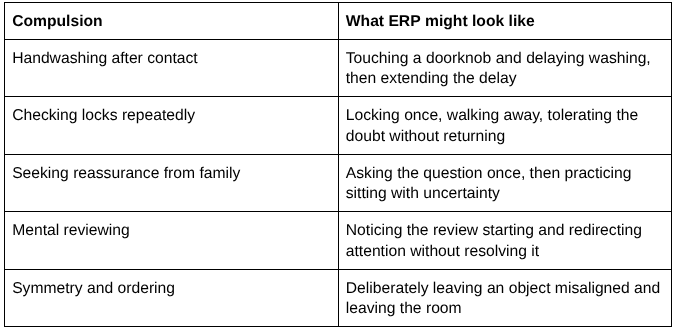
The work is uncomfortable by design, which is why it's done with a trained clinician who sets the pace. ERP is not about flooding you with your worst fear on day one. It's graduated, collaborative, and built around what you can tolerate this week rather than what you should be able to tolerate.
The Reassurance Trap for Families
Families get pulled into OCD without realizing it. Answering the same question repeatedly, checking the stove on someone's behalf, or adjusting household routines around contamination fears all feel like kindness. Each one strengthens the cycle.
Family accommodation is a well-documented factor in how entrenched OCD becomes, which is why programs generally include family sessions. The goal isn't withdrawing support. It's redirecting it toward something that helps rather than something that maintains the disorder.
Talking With We Conquer Together
If any of this has described your last ten years, the relevant fact is that OCD responds to the right treatment, and that treatment is specific. We Conquer Together offers residential mental health care for adults in Yorba Linda, serving people from across Orange County, with clinicians who work with obsessive-compulsive presentations and the conditions that often accompany them.
You can say the thought out loud on that call. It won't be the first time they've heard it.
Frequently Asked Questions
1. Is OCD curable?
OCD is considered a chronic condition, though symptoms can be reduced substantially with appropriate treatment. Many people reach a point where obsessions and compulsions no longer control their daily functioning, using skills learned in therapy to manage flare-ups.
2. Do I need medication for OCD?
Not always. ERP alone helps many people, while SSRIs at doses typically higher than those used for depression are frequently added when symptoms are severe. That decision is made with a prescriber based on your specific presentation.
3. What if my obsessions are about harming someone?
Harm obsessions are a recognized and common OCD subtype, and they reflect fear rather than intent. Clinicians who treat OCD encounter these regularly and will not treat you as dangerous for disclosing them.
4. How is OCD different from generalized anxiety disorder?
Generalized anxiety involves realistic worries about everyday concerns like money or health. OCD centers on specific intrusive thoughts paired with compulsions performed to neutralize them, and the content is often experienced as senseless even by the person having it.
5. Can OCD get worse over time?
Untreated OCD often expands, with compulsions taking longer and new obsessions attaching to different areas of life. Stress tends to intensify symptoms, which is why earlier treatment generally means less entrenchment to work through.
