
Every unforgettable event begins in a surprisingly ordinary place: an empty venue, a demanding brief, and an idea that exists only in someone’s imagination. The challenge is turning that idea into something people can see, hear, touch, and remember. From the first creative sketch to the final guest interaction, experiential events are built through a careful mix of storytelling, spatial design, technology, and human emotion. This is where ambitious thinking meets the practical craft of making it real.
From Spark to Staged Experience: A Practical Path
Start With the Single Idea Worth Dramatizing
A big idea comes to life at an event when it is cut down to one clear message. Guests then get a journey they can walk through. The message should fit in one sentence, such as "this product gives busy teams their afternoons back." If the team cannot say it that plainly, the event will not either.
Test the sentence against what the audience cares about. A message about speed means little to guests who mostly worry about cost. Clarity matters more than the size of the budget.
Translate the Idea Into an Experience Map
A good experience map breaks the event into arrival, discovery, one high point, and a closing takeaway. For each stage, note what the guest sees, does, and feels. Picture a travel app launch. Guests check in at a mock gate, find features in themed rooms, and leave with a printed boarding pass.
This map becomes the shared script for creative and production teams. Before signing with vendors, planning firms that handle destinations and production, Destination Concepts Event Management among them, usually draw this map first. That habit keeps the core idea intact when budgets and schedules start to shift.
Event Design Principles That Make Concepts Feel Real
Good event design treats the venue as a stage where every detail tells the same story. These principles set immersive events apart from rooms that are merely decorated:
Narrative coherence: the invitation, signs, staff outfits, and sound all support one story.
Guest agency: people choose, build, or solve something instead of just watching.
Sensory consistency: light, music, and materials match the mood of each stage.
Pacing: quieter stretches give the big moments room to land.
One unmissable peak: a single moment every guest shares and wants to post.
Decoration asks guests to look, while immersion asks them to act. Guests may snap a pleasant photo at a logo wall, yet it tells them little about the brand's purpose. An element that would fit any company's event is probably a gimmick.
Layering Story, Sensory Detail, and Interaction
Storytelling That Gives Guests a Role
Guests remember what they did far longer than what they were told. Cast them as testers or detectives. Build a puzzle around a product feature, or open a themed room with a clue from the invitation.
Sensory and Technology Layers That Earn Their Place
Deliberate picks for scent, sound, lighting, and texture pay off most when they stay uniform throughout. VR or AR earns its place when guests need to see something that is impossible to build on site. A screen that exists only to look modern adds cost, not meaning.
Personalization Without Overcomplicating
Personal touches need no delicate technology, as a welcome card with the guest's name or an on-site engraved gift shows. Pick two or three moments and do them well.
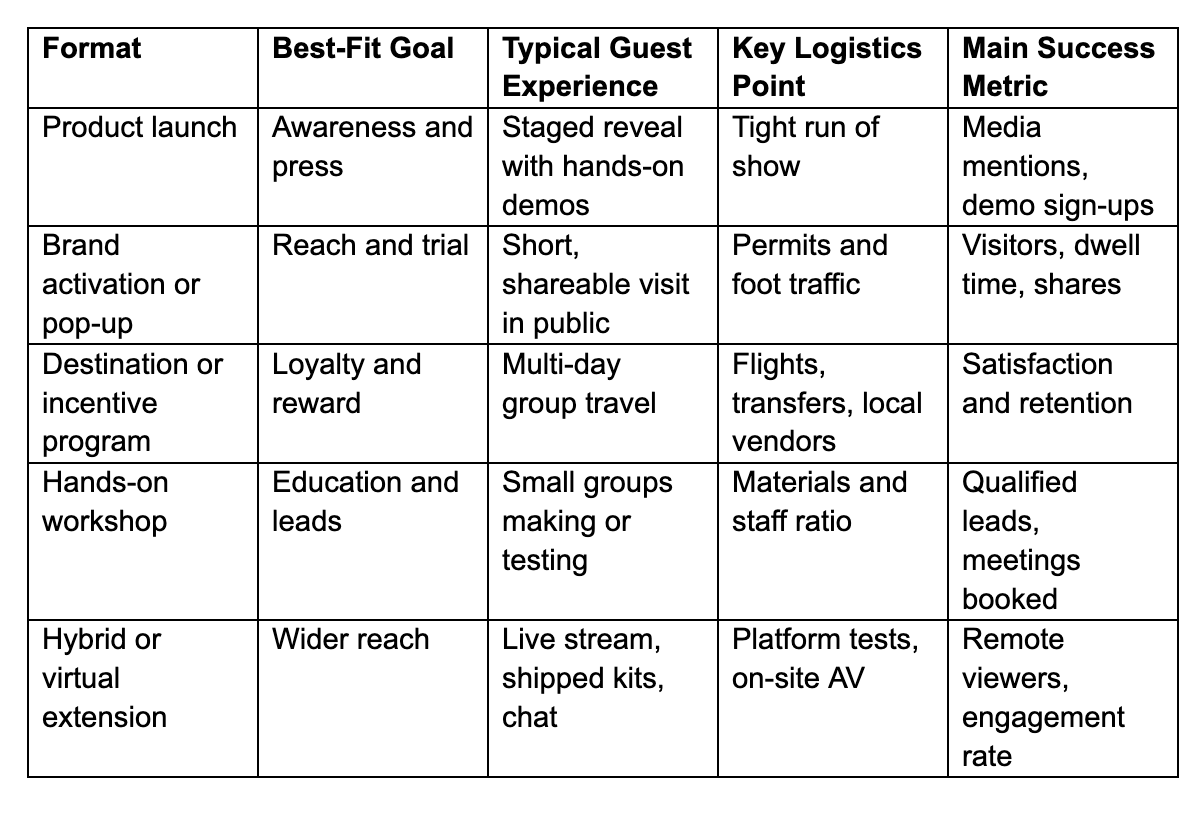
Choosing the Right Experiential Format for Your Goal
Format should follow the goal, not the latest trend. Well-planned events also feed the wider marketing plan. They produce months of photo and video content and give sales teams a warm reason to follow up.
Making It Happen: Logistics, Risk, and Measuring Results
Production and Destination Logistics to Plan Early
Even a brilliant concept depends on trucks, permits, and timing. Secure these details first:
Venue rules and permits for staging, sound, food, and outdoor use
Load-in windows, with every vendor on one shared timeline
Transport and guest flow, including airport transfers for travel groups
Access planning for mobility, hearing, vision, and dietary needs
Weather backups and a budget buffer of roughly 10 to 15 percent
In destination markets, local partners know which venues enforce noise curfews. They also know which suppliers deliver on time. Such insight heads off expensive last-minute problems.
Setting KPIs and Following Up After the Event
Tie each metric to the starting goal. Awareness maps to reach and press, leads to qualified contacts, and sentiment to survey scores. Gather the data quietly. Badge scans and short surveys work well, while clipboards at the peak moment spoil it. Shared standards make results easier to compare across events, and the Event Marketing Measurement Association publishes a free framework and survey questions for that purpose.
What People Ask About Experiential Events
How Should Planners Measure the Success of a Live Brand Activation?
Each goal should be fixed ahead of opening day, with a matching metric chosen for it. Attendance, dwell time, social shares, and captured leads show reach, while post-event surveys reveal how guests felt. Sales activity in the following weeks adds a business view. Pairing numbers with feedback makes the next budget easier to defend.
What Budget Considerations Matter Most When Planning a Large-Scale Participatory Event?
Fund the parts guests will touch first, such as set builds, technology, and trained staff. Then hold back about 10 to 15 percent for late changes. Permits, insurance, content capture, and reporting are often underestimated. Listing them line by line early keeps spending in check and stops cuts from hitting the core experience.
Which Mistakes Cause Interactive Brand Events to Fall Flat With Audiences?
Events tend to miss when goals are vague, activities feel too complicated, or the experience has little to do with what guests care about. Long lines, confusing signs, and staff who cannot explain the concept hurt too. A small test run, fewer steps to join in, and a few moments worth sharing keep people engaged.
Final Thoughts on Experiential Events
Every memorable event starts as one sentence and ends as hundreds of small choices. The craft lies in keeping those choices true to that sentence. Before the next planning meeting, write the core idea in one line, sketch the four-stage map, and name the peak moment the budget must protect.
Next, pick the format that suits the goal and write down any logistics that could derail it. Agree on two or three metrics before anything is booked. Teams that work in this order spend less time rescuing concepts late in production. They spend more time polishing the details guests will actually remember.
