
Tools from Unwinding Anxiety by Dr. Jud Brewer | 3 Takeaways
“Worrying does not take away tomorrow’s troubles. It takes away today’s peace.”
― Judson Brewer
In today’s world, you might assume that having access to clean water, reliable food, and stable shelter would reduce anxiety. Yet, a 2017 global study on Generalized Anxiety Disorder (GAD) revealed the opposite: lifetime anxiety prevalence is highest in high-income countries (5%), lower in middle-income countries (2.8%), and lowest in low-income countries (1.6%). This phenomenon has earned wealthier nations the nickname “the worried well.”
Dr. Jud Brewer’s Unwinding Anxiety explores why our survival brains, designed to keep us safe, now keep us stuck. Fear, our oldest emotion, uses a simple cue-behavior-reward system to teach us how to avoid danger—an instinct so basic that even sea slugs rely on it. Anxiety, however, hijacks this system. Unlike fear, which is rooted in immediate threats, anxiety thrives on uncertainty and misinformation, turning our thinking brains against us.
Brewer breaks down how anxiety habit loops form and offers a practical, science-based approach to breaking free. By combining mindfulness, curiosity, and an understanding of how our brains work, Unwinding Anxiety shows how to step out of worry and into clarity, even in a world of uncertainty.
3 Takeaways from Unwinding Anxiety by Dr. Jud Brewer
1. Stop Romanticizing Anxiety
We’ve all heard it before—or maybe even said it ourselves: “My anxiety makes me productive,” or “I wouldn’t be where I am today without my stress.” Dr. Jud Brewer confronts this myth head-on, arguing that anxiety is not the secret sauce for success. He cites the York-Dodson curve, a long-held but over-hyped belief that “a little anxiety improves performance.” Newer research reveals that this idea has been largely debunked. Only 4% of studies support the idea that anxiety enhances performance, while nearly half find a direct negative relationship between stress and success.
If you’re clinging to the belief that anxiety is your motivator, it’s time to reassess. Ask yourself: “Am I productive despite my anxiety, not because of it?” Consider how much energy stress drains from your day—clouding your thoughts and stealing your focus. Think of the greats—Usain Bolt smiling at the starting blocks, Michael Jordan with his tongue out mid-dunk. They weren’t anxious; they were in the zone.
What to do: Start noticing your own anxiety habit loops. When you feel it bubbling up, pause and question: Is this anxiety helping or harming me? Often, just observing it is the first step to breaking free.
2. Understand Your Stress Personality
Dr. Brewer revisits a 5th-century meditation manual, which categorizes behavior into three tendencies: approach (fight), avoid (flight), and go-with-the-flow (freeze). These aren’t just stress reactions—they shape how we navigate everyday life. He reframes these categories as tendencies, not labels. He further describes them as this:
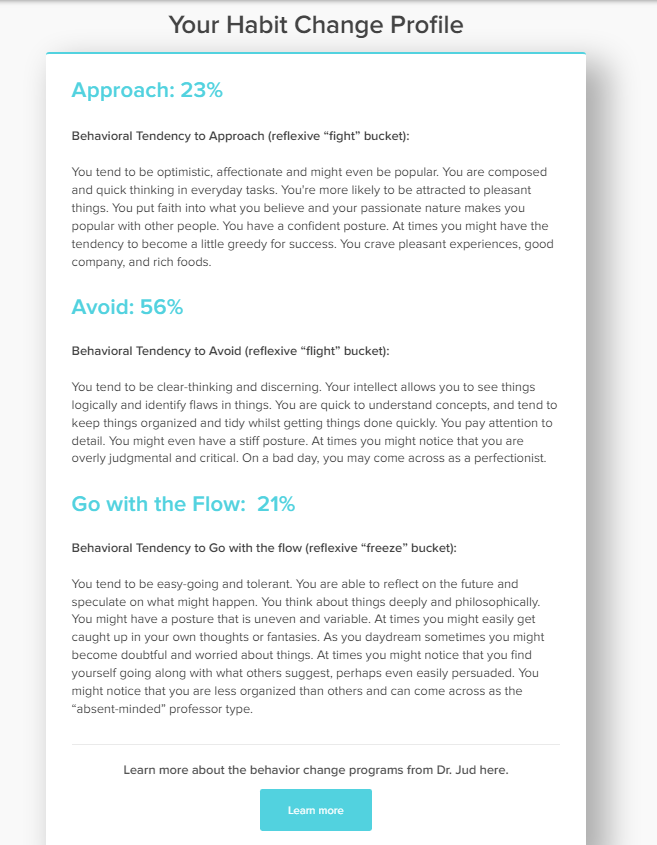
Approach type: You have a positive outlook and tend to be warm and loving, making you popular with others. You are composed and efficient in your daily tasks and are drawn to pleasant experiences. You have strong convictions and a passionate nature, which adds to your charisma. You carry yourself with confidence, walking proudly and aiming for success.
Avoid type: You have a sharp mind and are able to analyze situations logically, identifying flaws and areas for improvement. You are efficient and organized in your approach to tasks, paying close attention to detail. You may have a rigid posture and come across as overly critical or perfectionistic at times.
Go with the flow type: You are laid-back and open-minded, often considering different possibilities for the future. You enjoy deep thinking and philosophical musings, sometimes getting lost in your own thoughts and daydreams. You may occasionally become anxious or uncertain about things, but generally remain flexible and willing to go along with the suggestions of others. You may appear less organized than others and sometimes come across as dreamy.
Take Dr. Jud's 13-point quiz to determine which one you fall into. I discovered that I fall pretty heavily into the avoidant type (56%) followed by a near even split between approach (23%) and go with the flow (21%).
Recognizing these patterns allows us to work with—not against—our natural inclinations.
What to do: Take stock of your own tendencies and how they show up in moments of stress. Once you’re aware of these patterns, you can channel your strengths and soften the edges of your weaker spots.
3. Use Curiosity to Break the Cycle
One of Dr. Jud’s most practical tools for managing anxiety is what he calls “The Curiosity Stress Tool.” Instead of trying to “fix” your anxious thoughts, lean into curiosity. This might sound counterintuitive, but curiosity activates a different part of your brain—one that’s more open and less reactive.
Here’s the exercise in a nutshell:
Identify a Recent Stressful Moment
Think of a specific situation where you felt anxious or overwhelmed. The more vivid, the better.Pinpoint the Physical Sensation
Notice where the anxiety showed up in your body. Is it a tightness in your chest? A buzzing in your head? A clenching in your stomach? These physical sensations are often tied to the emotional experience of stress.Activate Curiosity
Instead of resisting the discomfort, focus on it with curiosity, like a detective examining a mystery. Mentally say, “Hmm… that’s interesting.” Ask yourself questions about the sensation:Is it on the left or right side?
Does it feel heavy or light?
Is it sharp, dull, or fluttering?
Does it change as you observe it?
Curiosity breaks the cycle of reactivity. Anxiety thrives on avoidance and rumination, but curiosity interrupts these patterns. By shifting your attention to what’s happening in your body and exploring it without judgment, you engage the prefrontal cortex, the part of the brain responsible for rational thinking and problem-solving. This approach, one that lies at the heart of meditation as well, allows you to view anxiety as a passing experience rather than an overwhelming force.
What to do: Next time anxiety strikes, take two minutes to try this exercise. Curiosity is like a circuit breaker for stress—it disrupts the loop and brings you back to a calmer state of mind. At first it will likely be frustrating and annoying but, with practice, it can have a significant impact on your mental health.
Related:

