
What Quality Supplement Manufacturing Really Means
The supplement aisle is a wall of bold promises. Every label claims to be the purest, the strongest, the best. Yet what really separates a good product from a bad one happens long before the label goes on.
It happens in the factory. The Sawgrass Nutra Labs standard behind a product, meaning how it is formulated, made, and tested, matters more than the marketing on the front. This guide explains what quality manufacturing looks like and how to spot it.
Why Does the Manufacturer Matter?
Most brands do not make their own supplements. They hire a contract manufacturer to do it for them.
A contract manufacturer is a company that formulates and produces supplements for a brand. The good ones run clean, certified facilities and test everything. The bad ones cut corners you never see.
That hidden step decides quality. Two products with identical labels can be made to wildly different standards. The factory, not the marketing, is where trust is earned. A brand can change its label overnight, but it cannot fake a clean, audited facility.
Why Do Manufacturing Standards Matter?
This is the single most useful term to know. It is the baseline every serious manufacturer meets. Skipping it is the easiest way for a cheap brand to quietly cut costs.
cGMP stands for Current Good Manufacturing Practices, the US Food and Drug Administration's rules for how dietary supplements are made, tested, and packaged. A cGMP-certified facility has cleared real, audited standards that an uncertified one has not.
Look for it on the label or the maker's site. A serious manufacturer, often working from a large dedicated facility of 40,000 square feet or more, will state its certifications plainly. These standards cover everything from raw-material checks to finished-product testing and record-keeping. They exist so every batch comes out consistent and contaminant-free.
What Does Third-Party Testing Add?
Third-party testing is independent lab analysis carried out by an outside body, not the brand itself. It is the proof behind the promise.
It matters because a company grading its own homework is not reassuring. Independent testing confirms the dose on the label is the dose in the bottle. It also screens for contaminants and banned substances. For anyone drug-tested for sport, that screening is essential, not optional.
How Do You Read a Supplement Label?
A label tells you most of what you need. You just have to know where to look. A few seconds of reading can save a lot of wasted money.

Run through these 5 checks before you buy:
Active dose. Confirm a useful amount, not a token sprinkle.
Third-party seal. Look for NSF, USP, or Informed Sport.
Full ingredient list. Watch for fillers and proprietary blends.
Maker details. A real company and address, not a mystery.
Certifications. cGMP, and organic or kosher if it matters to you.
For active men in particular, the evidence behind many exercise and performance supplements is thinner than the marketing suggests, so dose and quality matter more than hype.
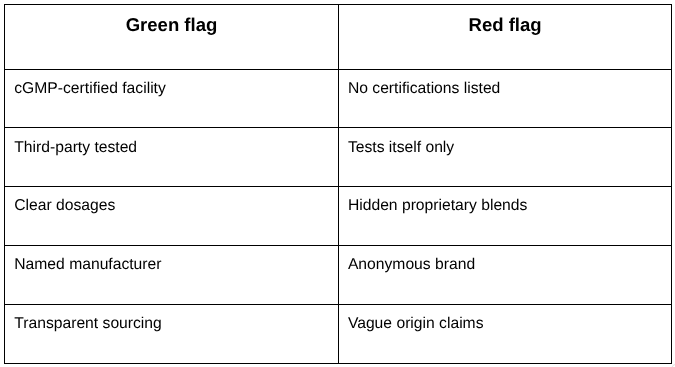
If a product hides the dose or the maker, treat that as your answer. Transparency is itself a quality signal.
Do Active Men Need Different Standards?
The basics apply to everyone, but active bodies have specific needs. Heavy training raises demand for certain nutrients.
That makes quality matter more, not less. When choosing supplements to support training, a clean, well-dosed product is worth far more than a flashy label. Even something as basic as a quality multivitamin is only as good as the facility that made it. Hard training burns through nutrients faster, so purity and consistency matter even more. A poorly made product is wasted money at best.
What to Remember
Most brands use a contract manufacturer, so the factory matters.
cGMP certification is the baseline quality standard to look for.
Third-party testing proves the label matches the bottle.
Read the label for dose, seals, ingredients, and the maker.
For active men, quality and dose beat marketing hype.
If a product hides its dose or maker, walk away.
Quality You Can Actually Trust
A good supplement is not the one with the loudest label. It is the one made in a certified facility, tested by an independent lab, and honest about what is inside. Learn the few signals that matter, and the wall of promises gets a lot easier to read. Spend your money on what is in the bottle, not what is printed on the front. Your body is worth more than a guess.
Frequently Asked Questions
What Does GMP Certification Actually Mean?
cGMP, or Current Good Manufacturing Practices, is a set of FDA rules for how supplements are made, tested, and packaged. A cGMP-certified facility has passed audited standards for cleanliness, quality control, and record-keeping. It is the baseline you should expect from any serious supplement maker, and a reasonable first filter when comparing brands.
Why Is Third-Party Testing Important?
Because a brand testing its own products has every incentive to look good. Independent, third-party testing verifies that the dose on the label is actually in the bottle and screens for contaminants and banned substances. Seals like NSF, USP, and Informed Sport signal that an outside lab has checked the product.
Are Expensive Supplements Always Better Quality?
Not necessarily. Price reflects branding and marketing as much as quality. A modestly priced product from a cGMP-certified, third-party-tested manufacturer can easily beat a premium-priced one with no certifications. Judge by the manufacturing standards and transparency, not the price tag or the packaging.
How Can I Tell Who Actually Makes a Supplement?
Check the label and the brand's website for the manufacturer and a real address. Reputable brands name their cGMP-certified facility and list certifications openly. If a product gives no maker, no location, and no testing information, treat that silence as a warning rather than a detail to overlook.
