
Cataract Surgery Cost Cape Coral: Why Two Quotes Can Differ by Thousands
In 2026, cataract-surgery quotes in Cape Coral swing from roughly $343 per eye after Medicare to more than $4,000 once elective extras are added. Both numbers can be accurate for the same operation. This guide breaks down the line items — covered costs, upgrade fees, and the charges that arrive on separate bills — so you can walk into your consult prepared, with a clear sense of which lines are fixed and which are yours to choose.
The Short Answer on Cost in Cape Coral
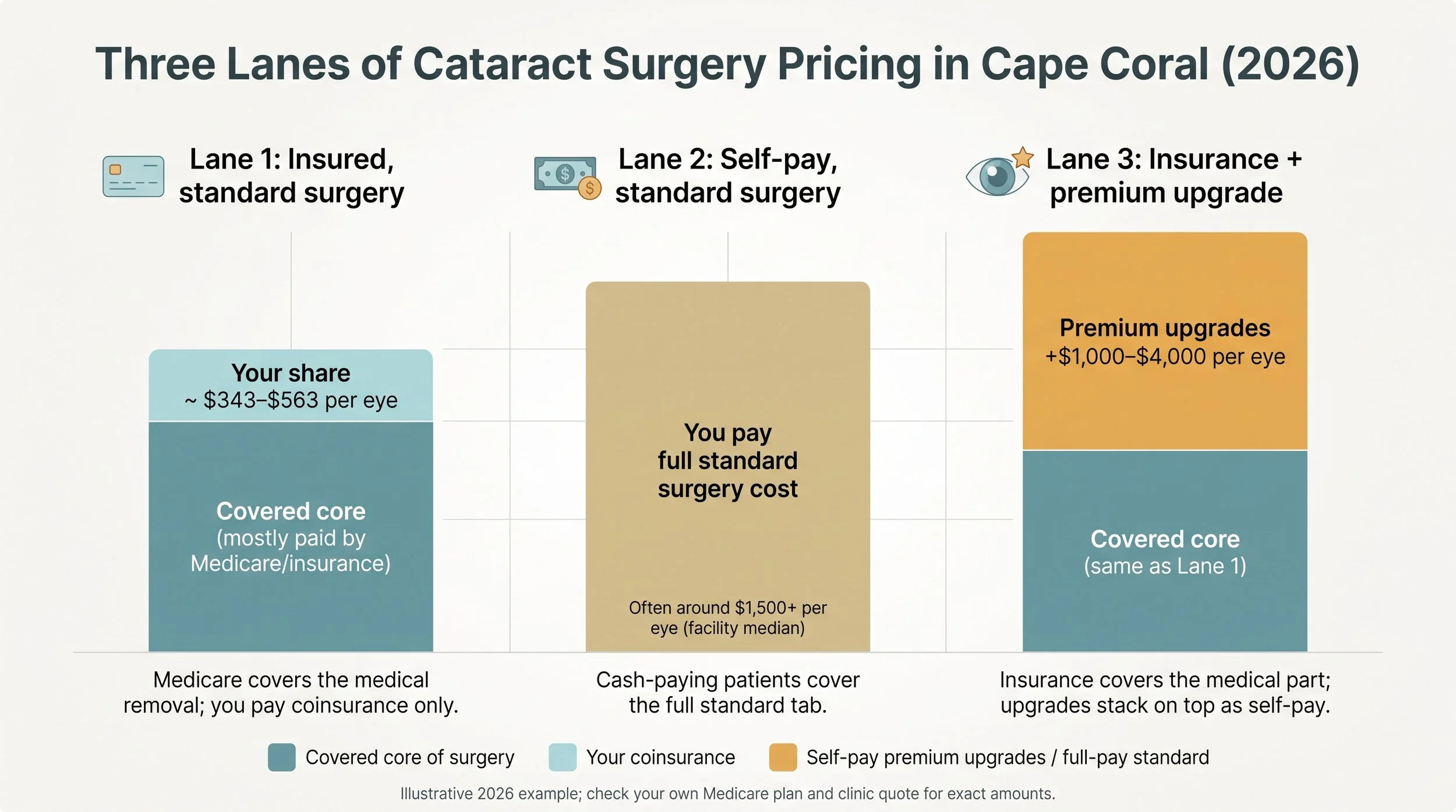
Think of pricing as three lanes. Pick your lane first and the math gets easy — and when you gather offers from Southwest Florida cataract surgeons, make sure each one tells you which lane it is quoting.
Lane 1: insured, standard surgery. Medicare's 2026 price tool shows CPT 66984 in an ambulatory surgery center at $1,717 total, with roughly $343 out of pocket after the Part B deductible. The same case in a hospital outpatient department averages $2,819 total and $563 to you.
Lane 2: self-pay, standard surgery. Cash patients cover the full tab. Cape Coral's New Choice Health snapshot lists a $1,499 median, with facility quotes from $725 to $2,250 before surgeon, anesthesia, or upgrades.
Lane 3: insurance plus a premium upgrade. Your plan still covers the medical removal, but every refractive extra - toric, multifocal, or light-adjustable lenses, laser guidance, extra testing - lands on your card. Upgrades usually add $1,000 to $4,000 per eye on top of Lane 1.
Why do local numbers feel scattered? One clinic advertises a facility fee that excludes surgeon, anesthesiologist, and lens, while cost tools bundle every party into one figure. Apples and oranges end up in the same basket.
First Make Sure Both Quotes Describe the Same Surgery
Before comparing dollars, confirm you are buying the same operation. Three checkpoints keep apples with apples.
Eye count. Cataract bills run per eye. If one quote lists the left eye only and another quietly rolls both eyes together, the math already doubles. Ask for "right eye," "left eye," or "two-eye plan" in plain words.
Lens category. A standard monofocal lens fixes the cataract but leaves you reliant on glasses at other distances. FDA-approved premium options add vision-correction features insurers do not cover. Make sure each estimate spells out the exact lens type, not just "IOL included."
Quote format. Some offices list every party line by line. Others bundle them into one price. Neither style is wrong, but mixing them hides real differences. Ask for a written breakdown so you can see who gets paid and for what.
The Lens Choice Is Usually the Biggest Price Swing
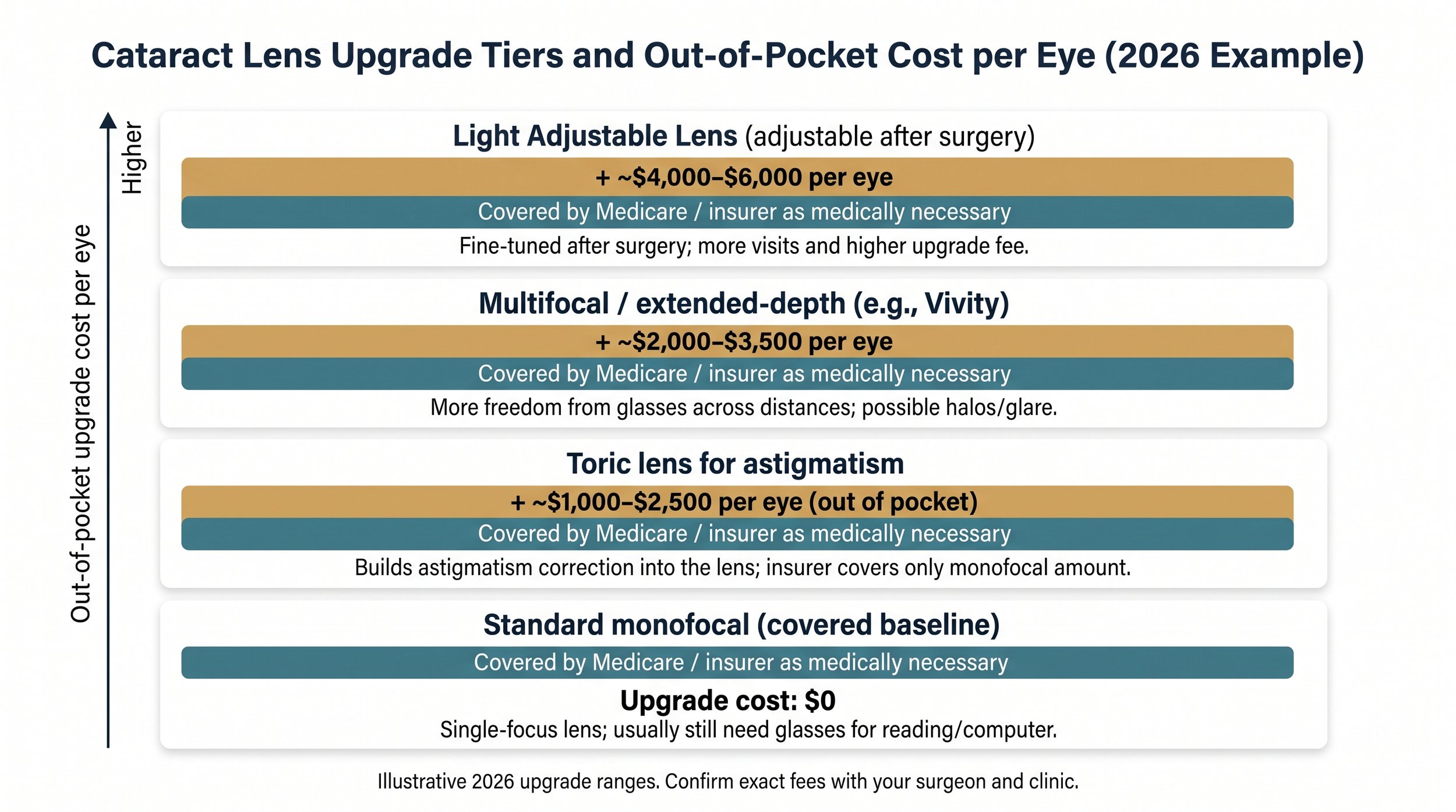
Replacing the cloudy lens is not one decision. It is four price tiers.
Standard monofocal — the covered baseline. This single-focus lens restores clear vision at one distance. Because it is medically necessary, Medicare and most insurers treat it as part of the covered procedure. You will likely still need glasses for reading or computer work.
Toric lens for astigmatism — add roughly $1,000 to $2,500 per eye. An FDA-approved toric implant builds astigmatism correction into the optic. Insurance pays only what a monofocal would have cost; the upgrade comes out of pocket.
Multifocal or extended-depth lens — add roughly $2,000 to $3,500 per eye. FDA-approved optics such as Vivity split light so you can shift from a boat's horizon to your phone without swapping glasses. Convenience carries a premium and possible trade-offs, such as halos in low light.
Light Adjustable Lens — add roughly $4,000 to $6,000 per eye. Surgeons implant the FDA-approved Light Adjustable Lens by RxSight, then fine-tune its power with painless UV-light sessions over several weeks. Flexibility costs more appointments and more money.
Ask every clinic to quote the monofocal price first, then add each upgrade, so you can see line by line how much sharper vision costs and whether the benefit is worth the jump.
The Surgery Site Can Change the Facility Bill
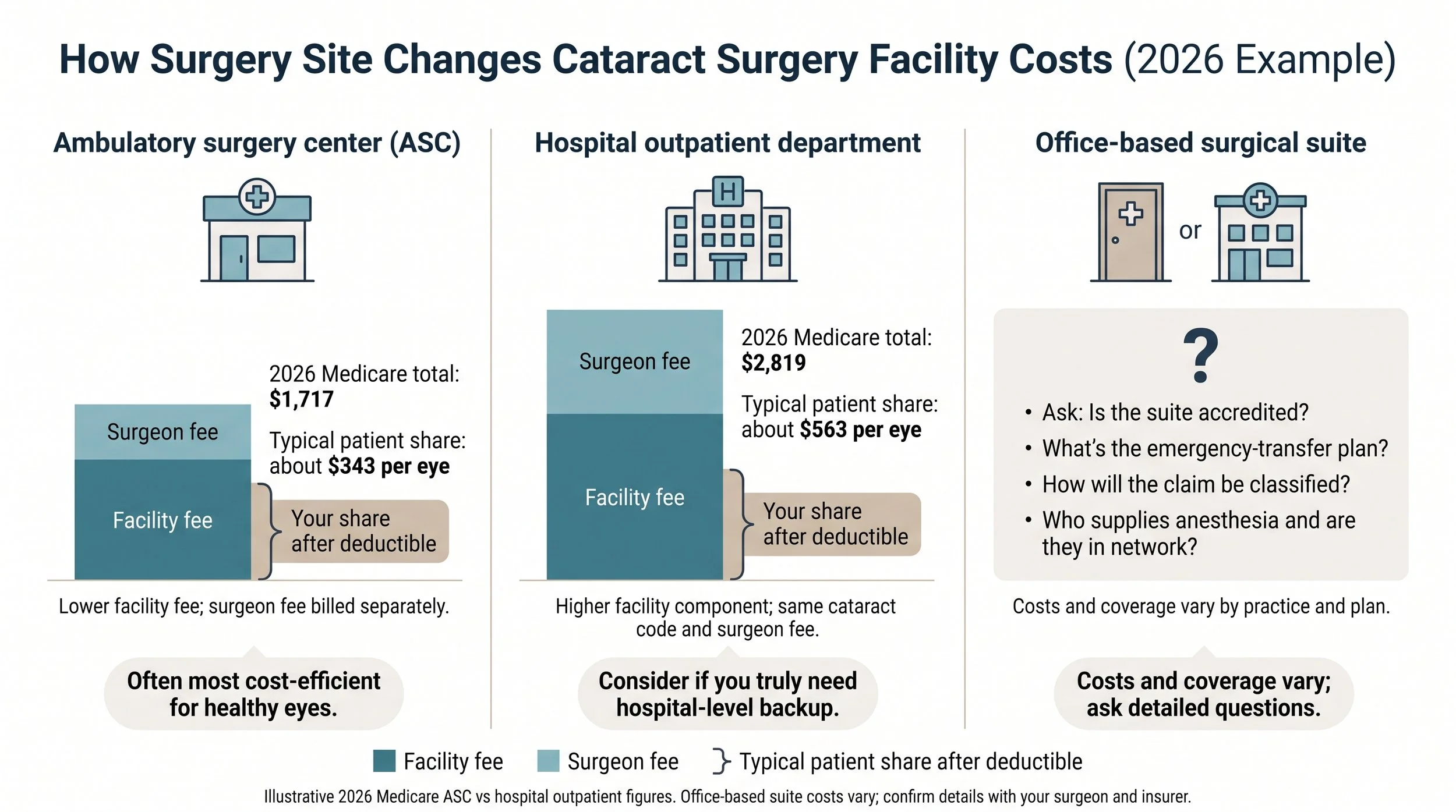
Where the surgeon operates matters almost as much as who operates.
Ambulatory surgery center. Medicare's 2026 database lists $1,717 total for CPT 66984, split into a $1,255 facility payment and a $462 surgeon fee, with the typical patient paying about $343 after the deductible. Lower overhead keeps prices lean. Confirm that both the center and its anesthesia group are in network, and ask for the facility's own charge in writing so you can stack it beside that Medicare allowance.
Hospital outpatient department. Move the same case into a hospital and Medicare shows $2,819 total, about $563 to you, driven mainly by a higher facility component. A hospital makes sense if you need 24-hour backup, but for a healthy eye you may be buying overhead rather than better vision.
Office-based surgical suite. A few Southwest Florida practices operate in their own accredited procedure rooms. Before agreeing, ask whether the suite is accredited, what the emergency-transfer plan is, how the claim will be classified, and who supplies anesthesia.
Four Bills Instead of One
A quote can look tidy until other companies send statements. Spot each one before surgery day.
Surgeon versus facility. Medicare lists an average $462 surgeon allowance for a standard ASC case, separate from the $1,255 facility payment. Ask whether the surgeon charge is bundled or arrives later.
Anesthesia. Most centers rely on an independent anesthesia group. If that group is out of network, one claim can dwarf your surgeon bill. Call your plan with the group's tax ID rather than relying on "we accept your insurance."
Diagnostics. Biometry and corneal scans are usually covered. Advanced testing tied to a premium lens often is not, and can run $150 to $300 per test.
Postoperative care. Routine visits fall under the global surgical fee, but the final refraction for glasses may trigger extra copays.
What Medicare Covers, and What It Does Not
Original Medicare pays 80 percent of medically necessary cataract surgery after you meet the Part B deductible ($283 in 2026). You cover the remaining 20 percent, and the amount changes with the surgery site.

According to Medicare's 2026 Procedure Price Lookup, everything beyond that core — premium lenses, laser fees, extra tests — is elective and comes straight from your pocket. A Medigap policy can absorb some or all of the 20 percent coinsurance, but it will not cover premium-lens upgrades or laser surcharges. Medicare Advantage plans vary widely, and Lee County residents can choose among 60 of them in 2026, so verify the surgeon, facility, and anesthesia group separately against your plan.
Ask the clinic to print two columns on your estimate, "covered" and "non-covered." The side-by-side view shows exactly which items push your bill above the coinsurance.
Cape Coral Factors That Complicate Local Price Shopping
Cape Coral quotes often sprawl beyond city limits. New Choice Health lumps Cape Coral together with surgery centers in Fort Myers and Bonita Springs, both 10 to 30 miles and a toll bridge away. One "local" price may hide a different ZIP code, facility fee, or anesthesia group.
Demand adds pressure. Cape Coral's population reached 236,264 in July 2025, a 21.8 percent jump since 2020, with one quarter of residents aged 65 or older. More retirees can mean packed calendars and higher prices for the most convenient slots.
Three steps cut through the fog: confirm the operating address rather than the consult office, call your plan with the surgeon, facility, and anesthesia tax IDs, and ask for a written 2026 fee schedule stamped with the clinic's logo and date.
How Two Quotes Can Differ by Thousands Without Either Being Wrong
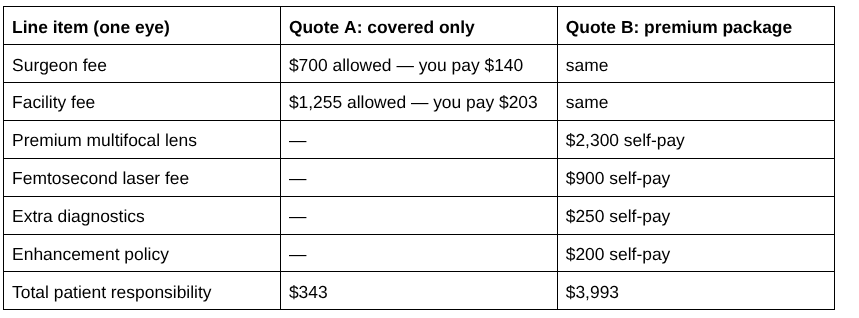
Stack two illustrative Cape Coral quotes side by side, using 2026 Medicare ASC figures and typical premium-upgrade fees.
Strip away the elective rows and Quote B shrinks to the same $343 core shown in Quote A. Add the extras to Quote A and the totals match. Verify lens type, laser use, and bundled tests before judging which office is cheaper. Most four-figure gaps live there, not in surgical skill.
Questions to Bring to Your Consultation
Cape Coral cataract surgeons quote in different formats, so a printed cheat sheet keeps the appointment focused and the estimate honest.
"What is my total cost per eye, assuming the 2026 Part B deductible is already met?"
"Are the surgeon, facility, and anesthesia group all in my network? May I have their tax IDs?"
"Will I receive any bill besides the ones listed here?"
"Which daily tasks — night driving, computer work, golf — shaped your lens recommendation?"
"How many routine visits are included, and what does an enhancement cost if my prescription misses the target?"
"Do you offer a paid-in-full discount or 0 percent financing, and what is the APR after any promotional period?"
Jot each answer beside the printed quote. Gaps, vague replies, and missing numbers highlight the lines most likely to balloon after you sign.
Conclusion
Cataract surgery quotes only make sense when you compare identical procedures line by line. Match eye count, lens type, technology, and site of service, then verify every provider's network status. With a clear written breakdown, you can spot true
