
Most of us have a habit of treating foot pain as something to push through. You had a long day, wore the wrong shoes, or went harder than usual on a run, and now your feet are complaining. Rest up, give it a day or two, and it will sort itself out.
That logic works fine for ordinary soreness. But there is a different kind of foot pain that does not follow that pattern. It keeps coming back. It follows a predictable schedule. It is worse at certain times of day or at certain activity levels, and it does not fully resolve the way normal post-exertion soreness does.
That kind of pain is not background noise. It is your body trying to get your attention, and it is worth listening to.

Acute vs. Chronic Foot Pain: What Is the Difference?
Before anything else, it helps to know what category your pain falls into. Acute pain has a clear cause and a clear timeline. You rolled your ankle, landed badly, or walked fifteen miles in new shoes. The pain is sharp and immediate, and with appropriate rest and care, it fades within a predictable window.
Chronic pain is different. It either persists beyond the point where it should have resolved, or it keeps returning to the same spot in the same pattern.
The same way understanding the difference between acute and chronic pain helps you make sense of what is happening in your shoulder or knee, that same framework applies directly to your feet. If your foot pain is still present after two weeks of reasonable rest and care, or if it has come and gone three or more times in the same location, that is chronic. And chronic pain has causes that are worth identifying rather than waiting out.
Pain Patterns That Deserve More Than a Rest Day
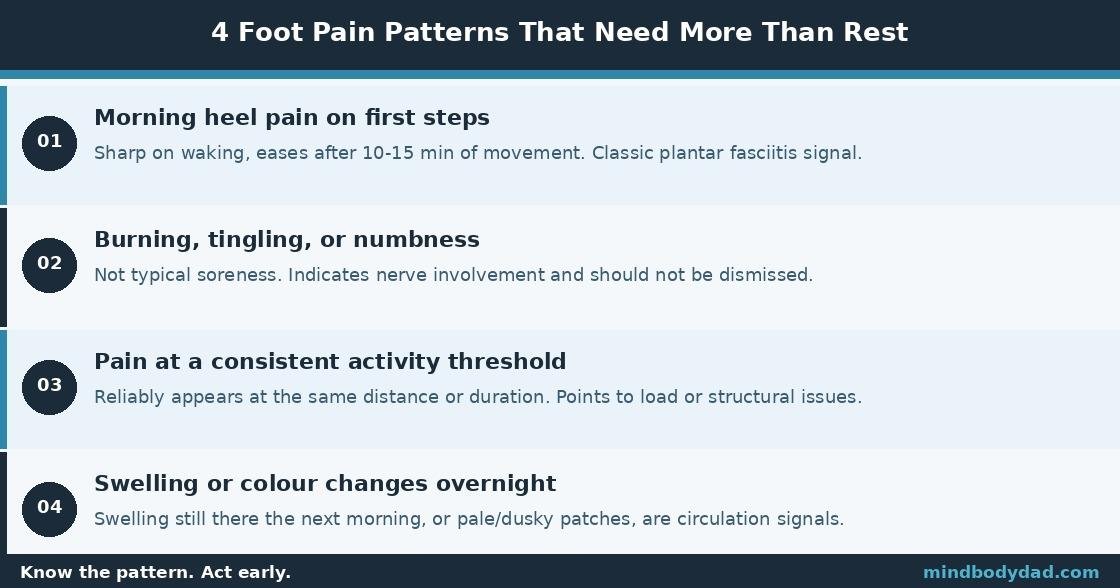
Not all persistent foot pain looks the same. Here are four specific patterns that show up regularly in clinical practice and what they tend to point toward.
Heel pain that is worst on your first steps in the morning. This is one of the most recognisable patterns in foot care. The pain is sharp when you first stand up, then gradually eases over the first ten to fifteen minutes of movement, and may worsen again after long periods of sitting or standing. This pattern is associated with plantar fasciitis, an inflammation of the connective tissue running along the bottom of the foot. It tends to respond well to targeted stretching and footwear changes early on, but left unaddressed for months, it becomes significantly harder to treat.
Burning, tingling, or numbness in the toes or sole. These sensations are not typical soreness and should not be treated as such. They indicate nerve involvement. Sometimes this originates from compression in the foot itself, but it can also point to systemic factors affecting nerve function throughout the body.
Pain that appears consistently at the same activity threshold. If you can walk comfortably for twenty minutes but pain reliably appears at a certain distance or duration, your foot is struggling with cumulative load. This often points to structural issues with the arch, footwear that is not providing adequate support, or early joint changes.
Swelling or skin colour changes that do not resolve overnight. Some foot swelling at the end of a long day is normal. Swelling that is still present the next morning, or any area of the foot that looks pale, dusky, or darker than the surrounding skin, is not. These are circulation signals that need professional evaluation.
When Foot Pain Is Pointing to Something Systemic
Here is where chronic foot pain becomes particularly important to take seriously. For people living with diabetes or pre-diabetes, the kind of persistent numbness, burning, and tingling described above is not just a foot problem. It is often the first noticeable symptom of peripheral neuropathy, nerve damage caused by sustained elevated blood sugar that progresses quietly over time.
What makes this significant is the combination effect. Neuropathy removes the pain signals that would normally alert you to a wound, blister, or pressure sore. At the same time, diabetes accelerates the narrowing of blood vessels that your body depends on to heal those same injuries. A small cut or blister that a healthy foot resolves in days can become a serious problem in a diabetic foot that cannot feel the injury and cannot heal it efficiently.
This is why persistent tingling, numbness, or burning in the feet, particularly in someone with diabetes or a family history of it, warrants a proper clinical evaluation rather than a wait-and-see approach. Seeking a diabetic foot care specialist early, before wounds or ulcers develop, is what changes the outcome. The earlier neuropathy is identified and monitored, the more options are available for slowing its progression and preventing complications.
What You Can Do Right Now
You do not need to wait for a diagnosis to start paying closer attention to your feet. A few simple habits make a real difference.
Inspect both feet daily, ideally at the same time each day. Look for any cuts, blisters, redness, or swelling, and use a mirror to check the sole if needed. Note when pain appears, how long it lasts, and whether it follows a pattern. Check your footwear honestly. Shoes that are too narrow, too flat, or too worn down in the heel contribute to more chronic foot problems than most people realise.
If you are thinking about increasing your physical activity level, being intentional about preparing your body for physical activity includes thinking about what your feet will be doing during that activity and what they need to do it safely.
If you notice numbness, burning, tingling, or any wound that is slow to heal, do not let it sit for weeks. Get it looked at.
Your Feet Are Telling You Something
Chronic foot pain is not an inconvenience to manage around. It is information. The patterns described here are not random. They correspond to specific structures and systems in your body that are working harder than they should, or not working as well as they once did.
The good news is that caught early, most of these conditions respond well to the right intervention. The window where straightforward treatment gets good results is wide. What closes that window is waiting too long, assuming it will sort itself out, and missing what your feet have been trying to tell you.
