
7 Best Informed Consent Software Tools for Healthcare Providers

A signed form does not always prove that a patient understood the decision being made. Healthcare providers need systems that support clear education, complete signatures, reliable records, and easier access to consent documents when questions arise.
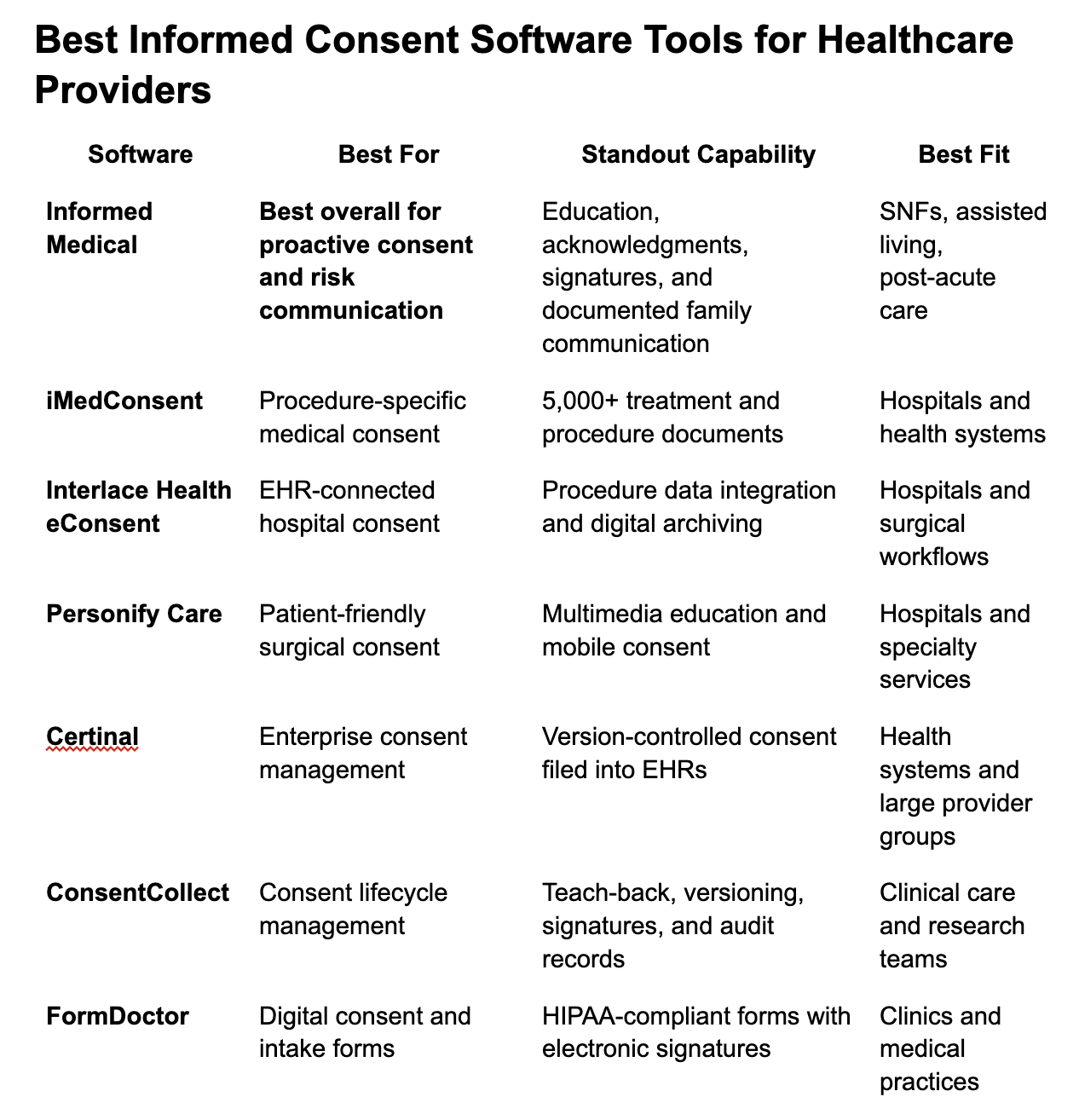
Modern informed consent software moves this process away from paper and disconnected PDFs. Some platforms specialize in patient education, while others focus on procedure libraries, EHR workflows, or digital forms. We reviewed seven options for different healthcare settings, including hospitals, clinics, skilled nursing facilities, and post-acute care providers.
Informed Medical
For SNF Risk management, Informed Medical is our top informed consent choice because it combines education with proof that important information was delivered. The platform supports educational content, digital acknowledgments, smart signing, audit trails, and communication records for residents and families.
Pros:
Provides educational videos alongside important care information
Captures digital signatures and signed acknowledgments
Automatically stores communications and signed documents in PointClickCare
Offers more than 200 ready-made documents for different care situations
Cons:
Primarily designed around long-term and post-acute care
May be less suitable for hospitals needing large surgical procedure libraries
iMedConsent
Taylor Healthcare's iMedConsent digitizes informed consent for treatments and medical procedures. Providers can personalize documents with risks, benefits, alternatives, and treatment details before collecting electronic signatures. Its content library covers more than 5,000 procedures across 37 specialties and connects with major EHR systems.
Key features:
Clinically reviewed procedure consent library
Mobile signature capture
Epic and Oracle/Cerner integration
Pros:
Large ready-made medical procedure library
Strong fit for hospital EHR workflows
Cons:
Its health-system focus may be excessive for smaller practices
A large procedure library offers less value to providers with narrow consent needs
Interlace Health eConsent
Interlace Health replaces paper consent forms with digital workflows that connect directly with clinical systems. It can pull procedure data into the consent process and supports single sign-on for staff. Completed documents remain accessible electronically instead of moving through manual scanning and archiving steps.
Key features:
EHR integration
Procedure data integration
Clinic-to-hospital consent workflows
Pros:
Keeps consent closer to existing hospital workflows
Reduces manual document handling and archiving
Cons:
Hospital-focused functionality may be more than small clinics require
Organizations need the right EHR setup to gain the full workflow benefit
Personify Care
Personify Care delivers digital consent through patient pathways that can be accessed remotely on mobile devices. Providers can add procedure information, videos, reminders, and electronic signatures to guide patients before treatment. The software also connects with EMR and patient administration systems for data sharing and documentation.
Key features:
Video-assisted patient education
Mobile digital signatures
Automated reminders and notifications
Pros:
Strong focus on patient understanding before signing
Supports both surgical and financial consent workflows
Cons:
Consent sits within a wider patient pathway platform
Building detailed digital pathways can require more setup than basic e-signing
Certinal
Certinal provides digital consent, intake, electronic signatures, and document controls within one healthcare platform. Consent records can be version-controlled and filed into systems such as Epic, Cerner, and MEDITECH. The platform also supports healthcare compliance requirements across several markets.
Key features:
Digital consent version control
EHR document filing
Legally captured electronic signatures
Pros:
Covers consent beyond a single department or procedure
Designed for large healthcare workflows
Cons:
Broad functionality may be unnecessary for consent-only projects
Enterprise integrations can involve more planning than standalone digital forms
ConsentCollect
ConsentCollect manages the consent process from document creation through approval, education, signature, and final audit storage. Providers can add teach-back questions to check understanding instead of relying only on a signature. The platform also supports FHIR-based healthcare workflows and integrations with EHRs and other clinical systems.
Key features:
Patient teach-back checks
Consent version management
Timestamped audit records
Pros:
Covers the full consent lifecycle
Includes tools for checking patient comprehension
Cons:
Some research-grade controls may be unnecessary for simple clinical consent
Advanced system integrations can require external credentials and configuration
FormDoctor
FormDoctor turns medical paperwork into secure online forms that patients can complete before an appointment. Practices can collect consent signatures, set required fields, send reminders, and automatically place completed documents into patient charts. It also supports EHR connections, HL7 data, custom APIs, and encrypted patient submissions.
Key features:
HIPAA-compliant form builder
Electronic signatures
Automated patient reminders
Pros:
Simple option for clinics moving paper forms online
Combines consent with broader patient intake
Cons:
Focuses more on forms than guided informed consent education
Providers may need to develop and maintain their own procedure-specific consent content
What to Look for in Informed Consent Software
Good Informed Consent software should help patients understand a decision before capturing their agreement. Healthcare providers should therefore evaluate more than electronic signature functionality when comparing platforms.
Patient Understanding Should Come Before Signing
Consent starts with explaining the treatment, possible risks, benefits, and available alternatives. Look for software that can deliver this information through readable documents, videos, images, or other patient-friendly formats. Features such as comprehension checks can provide another way to confirm that important information was understood.
Consent Records Should Be Easy to Defend
Healthcare teams may need to retrieve consent records months or years after they were created. Timestamps, document versions, signatures, delivery records, and audit trails provide useful evidence of how the process happened. The software should also prevent completed documents from disappearing into separate inboxes, folders, or paper files.
The Workflow Should Fit Existing Clinical Systems
A consent platform should reduce staff work rather than create another place to enter patient information. EHR integration can help populate patient details and return completed records to the correct chart. Providers should check integration options, staff access, remote signing, and document storage before choosing a system.
Conclusion
The right informed consent platform depends heavily on where and how consent happens. Hospitals may need large procedure libraries and deep EHR connections, while smaller practices may prefer simple digital forms and remote signatures.
Informed Medical takes a different approach by placing education and documented communication at the center of the process. This makes it particularly strong for skilled nursing and post-acute providers where family understanding can affect complaints, trust, and legal exposure. Other platforms on this list provide strong choices for surgical consent, hospital workflows, patient intake, and enterprise consent management.
