
Efficient Financial Management Solutions for Healthcare Professionals

Running a medical practice is genuinely hard. You're pulled in every direction, patient care, staffing headaches, endless compliance checklists, and somewhere in that chaos, the finances quietly stop getting the attention they deserve. Sound familiar?
The encouraging part is that smarter financial systems built specifically for practices like yours actually exist. From cleaner billing workflows to forward-thinking tax strategy, the right healthcare financial management solutions can transform how your practice runs, stay compliant, and build toward something lasting.
Strategic Foundations of Healthcare Financial Management
Good financial management doesn't materialize out of thin air. It's built deliberately, through consistent habits stacked over time. Before you jump into tools and tactics, it's worth grounding yourself in the principles that hold all of it together.
Why Efficient Financial Management Matters for Medical Professionals
Practices that take efficient financial management for medical professionals seriously, rather than treating it as a reactive chore, consistently outperform those that don't. When you're watching cash flow with regularity, decisions get sharper. There's less guesswork. Fewer ugly surprises. And far more bandwidth to actually focus on patient outcomes.
Here's a number worth sitting with: up to 80% of medical bills contain at least one error. That's not a minor data point. That's a signal that meaningful revenue is quietly leaking out of your practice before it ever hits your account.
The Role of Bookkeeping in Sustainable Practice Growth
Every thriving practice has one thing in common: accurate, consistent financial tracking. Prioritizing bookkeeping for medical practices as a non-negotiable part of your operations keeps cash flow visible, strengthens your compliance posture, and sharpens the decisions you make at every growth stage. It also makes tax season significantly less painful. Think of it less as a back-office task and more as a strategic lever.
Getting clear on why financial management matters is a solid start. But knowing where to build that foundation, through disciplined, consistent bookkeeping for medical practices, is genuinely what separates practices that flourish from the ones that just get by.
Key Financial Management Solutions Tailored to Healthcare Practices
Principles matter. But principles without action are just good intentions. Now that the strategic foundation is clear, let's talk about what actually putting these ideas to work looks like day-to-day.
Building a Monthly Financial Rhythm That Sticks
Any meaningful approach to healthcare financial management solutions starts with a reliable monthly routine. Reconciling reimbursements, categorizing expenses, reviewing outstanding tax obligations, and generating financial reports that actually get read, these aren't glamorous tasks, but they're the ones that prevent year-end scrambles.
When this rhythm becomes a habit, problems surface early. That's the difference between catching a billing discrepancy in week two versus discovering it in month eleven.
Best Practices That Raise Accuracy and Lower Risk
Accuracy isn't just about good intentions; it requires systems behind it. Training your staff on billing codes, documenting workflows clearly, and ensuring your billing processes stay tightly aligned with bookkeeping for medical practices are the kinds of steps that meaningfully reduce costly errors and dramatically cut audit exposure.
Many practices also benefit from outsourcing specialized financial functions to experts. That's not a sign of weakness; it's practical wisdom. You get professional-level accuracy without the overhead of building a full internal team.
Automation and Integration for Real-Time Financial Visibility
This is where revenue cycle management for healthcare professionals genuinely earns its keep. When your EHR platform, billing software, and accounting tools actually talk to each other, errors fall, and collections accelerate.
Cloud-based automation removes the manual data entry that creates most billing mistakes in the first place, and it gives you real-time visibility into what's coming in and what's flowing out, without digging through a mess of spreadsheets.
Advanced Tools and Innovations Worth Knowing About
You've got the essentials working. Good. But the most forward-thinking healthcare professionals are already leveraging the next generation of financial technology, and the gap between early adopters and late movers tends to widen fast.
AI-Driven Forecasting and Financial Insight
AI-powered RCM solutions are projected to grow at a 14.2% CAGR from 2025 to 2030. That growth isn't hype; it reflects real confidence in what these tools deliver: cleaner claims, smarter denial prediction, and cash flow forecasting that shifts your practice from reactive to proactive.
AI doesn't replace your financial team. It makes their work sharper, faster, and a whole lot less error-prone.
Emerging Security Technologies in Healthcare Finance
As AI reshapes financial forecasting, newer security frameworks are working to protect the data powering those insights. Blockchain-based audit systems, for example, are beginning to appear in healthcare finance, creating tamper-proof financial records that support both compliance and long-term record integrity.
Widespread adoption is still a few years out, but practices paying attention now will adapt far more easily when the standards solidify.
Purpose-Built Platforms for Healthcare Billing Structures
Modern practice management platforms now bundle revenue cycle features, financial reporting, and compliance tools into a single environment.
These aren't generic accounting tools awkwardly retrofitted for healthcare; they're designed from the ground up with your payer structures, billing rules, and regulatory obligations already baked in.
Action-Driven Strategies for Practice Owners
Knowing what's available is empowering. But real change happens when you translate that knowledge into a structured routine that runs consistently, month after month, without fail.
A Practical Monthly Action Plan
Your monthly financial routine should cover: reimbursements received versus expected, accounts receivable aging, deductible expense tracking, and financial reports compared against prior periods. Straightforward? Yes. Powerful when done consistently? Absolutely.
If your monthly review reveals a growing backlog of unpaid insurance claims, AR recovery services can help resolve denials, follow up with payers, and recover outstanding reimbursements before they become harder to collect.
Proactive Cash Flow and Scenario Modelling
Staying on top of monthly tasks creates financial order. But anticipating what's coming, especially in an industry where reimbursement delays are practically a given, builds genuine resilience.
Ask yourself: What happens if reimbursements drop 10% for two straight months? Building scenario models around claim lags and patient volume shifts gives your practice the stability to weather uncertainty without panic.
Compliance Practices That Actually Reduce Risk
Forecasting protects revenue. But without strong compliance running in parallel, even financially healthy practices stay vulnerable. Maintaining detailed, secure, and accurate bookkeeping for medical practices keeps both regulatory exposure and audit risk meaningfully lower, and that matters more than most practice owners realize until it's too late.
Growing Your Practice Through Financial Empowerment
Once your action plan and compliance foundation are solid, the conversation shifts entirely. You're no longer just surviving financially; you're positioned to grow with intention.
Financial Planning Beyond the Current Quarter
Sound financial planning for healthcare professionals means looking further than the next 90 days. Reinvesting in technology, staff development, or expanded services requires knowing your numbers with enough confidence to act decisively.
Building a three-month cash buffer and partnering with a CPA or fractional CFO are practical steps many growing practices put off far too long.
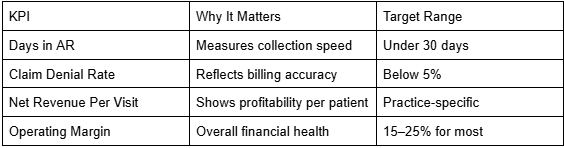
KPIs Every Practice Should Actually Be Tracking
Ambitious plans only deliver results if you're measuring whether they're working. Here's what deserves consistent attention:
Frequently Asked Questions
What are the 5 P's of finance?
The five foundational elements are Planning, Position, Protection, Performance, and Perspective. Together, they provide a structured framework for organizing and managing financial decisions consistently.
What are the 3 C's of healthcare?
Cost, Care, and Coverage. Cost refers to what consumers pay out of pocket; Care addresses service quality; Coverage relates to insurance access and what patients can realistically afford to receive.
Why does integrating billing and accounting matter for compliance?
When these systems share data, discrepancies get caught faster, audit trails stay intact, and regulatory reporting becomes more accurate, which directly reduces the risk of costly compliance violations or unnecessary claim denials.
Final Thoughts
Financial clarity isn't optional for healthcare professionals; it's the bedrock that everything else is built on. From disciplined bookkeeping and automated billing to smart forecasting and compliance confidence, the right financial systems protect what you've built and fuel what comes next.
Don't wait for a cash flow crisis to take this seriously. The practices that genuinely thrive over the long haul are the ones that treat financial management as a living priority, not something to revisit once a year and hope for the best.
Related:
