
Private Health Insurance vs. ACA Marketplace Plans for the Self-Employed

Leaving traditional employment can provide greater freedom, but it also means taking responsibility for benefits that an employer may have previously handled including health insurance. For freelancers, independent contractors, consultants, entrepreneurs, and small-business owners, choosing the right health coverage can be challenging.
Two options that often come up are private health insurance and ACA Marketplace plans. While both can provide health coverage, they can differ considerably in eligibility, pricing, provider networks, benefits, and enrollment requirements.
Understanding these differences can help self-employed individuals make a more informed decision instead of choosing a plan based solely on the monthly premium.
Why Health Insurance Can Be More Complicated When You're Self-Employed
Employees who receive employer-sponsored health insurance typically have their employer help with premiums and provide a limited selection of plans. When you work for yourself, you generally have to research plans, compare costs, determine eligibility, and handle enrollment on your own.
Your needs may also be different from those of a typical employee. For example, you may want:
Access to a broader network of doctors
The ability to see specialists
Coverage that works across multiple states
Predictable out-of-pocket costs
Prescription drug coverage
A particular deductible or coinsurance structure
Coverage for yourself and family members
A plan that fits your business income and budget
This is why comparing the type of coverage—not just the monthly premium—is important.
What Are ACA Marketplace Plans?
ACA Marketplace plans are health insurance policies offered through the Health Insurance Marketplace established under the Affordable Care Act.
Depending on income and circumstances, eligible individuals may qualify for premium tax credits or other cost assistance. Marketplace plans also follow ACA requirements regarding essential health benefits and protections for people with pre-existing conditions.
For many self-employed people, the Marketplace is an important option to investigate.
However, Marketplace plans can vary by state, insurer, network, deductible, copays, coinsurance, and maximum out-of-pocket costs. A plan that looks inexpensive based on its monthly premium may have a higher deductible or a more limited provider network.
When an ACA Marketplace Plan May Make Sense
You want ACA-compliant coverage.
You may qualify for premium assistance.
You have pre-existing medical conditions.
You want coverage with the protections provided by the ACA.
Your preferred doctors participate in the plan's network.
You are comfortable with the available deductible and cost-sharing structure.
The important point is to evaluate the total cost and coverage, rather than focusing only on the monthly premium.
What Is Private Health Insurance?
Private health insurance refers to coverage purchased outside the ACA Marketplace. Depending on the specific policy, private plans may have different eligibility requirements, underwriting rules, benefits, networks, and pricing structures.
Some private health insurance options are designed specifically for individuals who don't receive coverage through an employer, including certain self-employed professionals and business owners.
For eligible applicants, these plans may provide features that are attractive to people who prioritize provider choice or particular plan structures.
However, private insurance is not automatically better than Marketplace coverage. Eligibility and benefits can vary significantly from one plan to another, so applicants should carefully review the terms before enrolling.
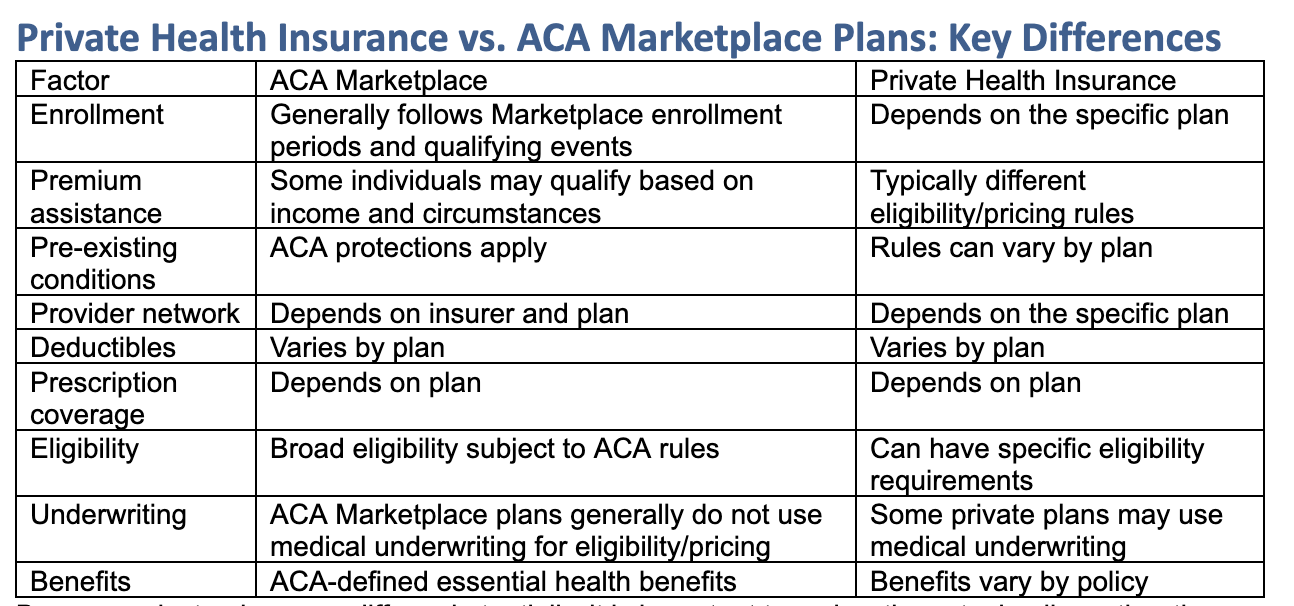
Because private plans can differ substantially, it is important to review the actual policy rather than assuming every private plan works the same way.
Don't Compare Plans Based Only on Monthly Premiums
A low monthly premium can be appealing, especially when you're responsible for paying the entire cost yourself. But the premium is only one part of your potential healthcare expenses.
Suppose Plan A costs $300 per month while Plan B costs $450. At first glance, Plan A appears to be the better deal.
But what happens if Plan A has:
A significantly higher deductible
Higher coinsurance
A narrower provider network
Higher prescription costs
Meanwhile, Plan B may have a higher premium but lower out-of-pocket expenses when you actually receive medical care.
When comparing health insurance, look at:
Monthly premium + deductible + copays + coinsurance + out-of-pocket maximum + prescription costs + provider network
This gives you a much more realistic picture of what the plan could cost.
Provider Networks Can Be Especially Important for the Self-Employed
If you've built a relationship with specific doctors or specialists, check whether they participate in the plan before enrolling.
This is particularly important for self-employed people who may travel frequently or operate their business across different locations.
Ask:
Is my primary care doctor in-network?
Are my preferred specialists covered?
Which hospitals participate?
Can I see an out-of-network provider?
What happens if I need medical care while traveling?
Is the network local, regional, or broader?
What About Prescription Coverage?
Prescription costs can also make a major difference. If you regularly take medication, check the plan's formulary before enrolling. Two plans can have very different costs for the same prescription.
Check:
Whether your medications are covered
Which tier your medications fall into
Copays or coinsurance
Deductibles that apply to prescriptions
Preferred pharmacies
Mail-order options
Prior authorization requirements
This step can prevent unpleasant surprises after enrollment.
Consider Your Health and Financial Situation
There isn't a single health insurance solution that works for every self-employed person.
Someone who rarely visits a doctor may prioritize a different combination of premium and deductible than someone who regularly sees specialists or takes prescription medication.
Similarly, a healthy 1099 contractor with variable income may have different priorities than an established business owner with predictable earnings and a family to cover.
Before choosing a plan, consider:
Your expected healthcare usage
Your monthly budget
Your emergency savings
Your preferred doctors and hospitals
Prescription requirements
Your family members' healthcare needs
Your eligibility for financial assistance
The plan's deductible and maximum out-of-pocket cost
Questions to Ask Before Choosing a Plan
What will I actually pay each month?
Don't forget premiums, deductibles, copays, coinsurance, and prescriptions.
Are my doctors in-network?
Verify this directly rather than assuming they are covered.
What happens if I need specialist care?
Understand referral requirements and specialist coverage.
Are my medications covered?
Check the formulary and expected costs.
Can I afford the deductible?
A plan with a low premium but a very high deductible may not be practical if you don't have sufficient emergency savings.
Am I eligible for this particular plan?
This is especially important when considering private health insurance because eligibility requirements can differ between policies.
Which Option Is Better for Self-Employed Workers?
There is no universal answer.
An ACA Marketplace plan may be attractive to someone who wants ACA protections and may qualify for financial assistance. A private health insurance plan may be worth investigating for someone who meets its eligibility requirements and is looking for different network, benefit, or pricing options.
The right decision depends on your healthcare needs, income, budget, eligibility, preferred providers, and tolerance for out-of-pocket expenses.
Instead of asking, "Which type of insurance is better?", a better question is:
"Which type of coverage best fits my specific healthcare and financial situation?"
That approach can lead to a much more informed decision.
Exploring Private Health Insurance Options for the Self-Employed
For self-employed professionals who want to investigate alternatives beyond traditional employer-sponsored coverage and ACA Marketplace plans, Medicare Sharks provides information about private health insurance options available to eligible individuals, including self-employed workers, entrepreneurs, consultants, and independent contractors. Their guide to private health insurance for self-employed individuals explains important considerations such as eligibility, provider networks, deductibles, prescriptions, and plan costs. As with any health insurance decision, it's important to review the specific plan terms and eligibility requirements before enrolling.
Disclaimer: This article is intended for general informational purposes and should not be considered insurance, legal, tax, or financial advice. Health insurance eligibility, benefits, pricing, and availability vary by plan, state, and individual circumstances.
