
The Minimum Effective Dose of Exercise: A Practical Weekly Schedule
“We do not rise to the level of our goals. We fall to the level of our systems.”
—James Clear
You don’t need endless hours at the gym to get fit. In fact, focusing on the Minimum Effective Dose (MED)—the least amount of exercise required to gain meaningful health benefits—is the smartest way to optimize your time and energy.
I’ve written a lot about the science behind the MED of various types of exercise. Today I’ll provide you with an organized, practical guide to efficiently cover lifting, walking, HIIT, and Zone 2, fully meeting minimum dose requirements, including rest breaks.

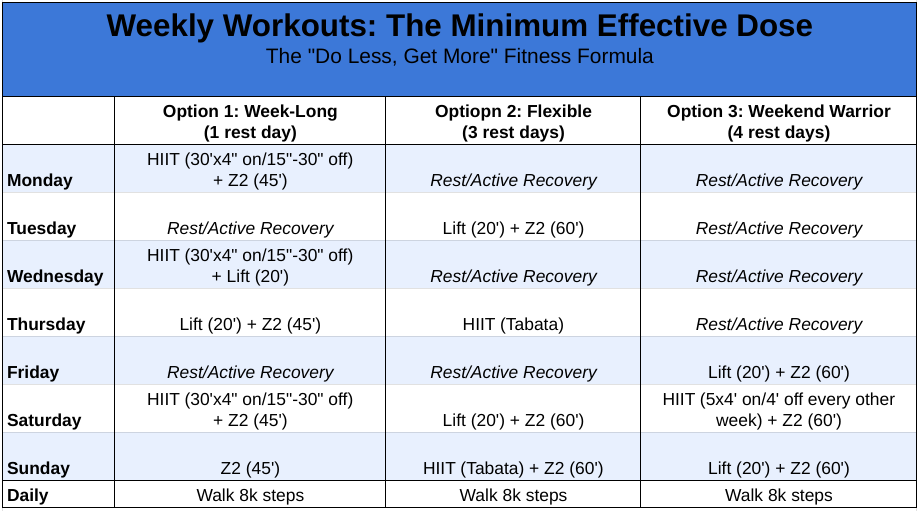
The Minimum Effective Dose of Exercise (Choose Your Schedule)
Option 1: Week-Long (1 Rest Day)
Ideal if you can commit to short sessions almost every day.
Monday
Zone 2 (45’)
HIIT (30x4” on/15-30'“ off)
Tuesday
Rest or active recovery (walk, mobility, light movement)
Wednesday
HIIT (30x4” on/15-30'“ off)
Lift (20’)
Thursday
Zone 2 (45’)
Lift (20’)
Friday
Rest or active recovery
Saturday
Zone 2 (45’)
Alternate every other week: HIIT (30x4” on/15-30'“ off) & VO2 Max 4x(4’ on/4’ off)
Sunday
Zone 2 (45’)
Daily
Walk 8,000 Steps or 6.000 steps if you’re over the age of 60
Option 2: Flexible (3 Rest Days)
For those who need more recovery or have variable schedules.
Monday
Rest/Active Recovery
Tuesday
Zone 2 (60’)
Lift (20’)
Wednesday
Rest/Active Recovery
Thursday
HIIT (Tabata, 4’)
Friday
Rest/Active Recovery
Saturday
Zone 2 (60’)
Lift (20’)
Sunday
Zone 2 (60’)
Alternate every other week: HIIT (Tabata, 4’) & VO2 Max 4x(4’ on/4’ off)
Daily
Walk 8,000 Steps or 6.000 steps if you’re over the age of 60
Option 3: Weekend Warrior (4 Rest Days)
Perfect if your weekdays are slammed and you can push harder on the weekends.
Monday–Thursday
Rest/Active Recovery (but still getting the minimum amount of steps)
Friday
Zone 2 (60’)
Lift (20’)
Saturday
Zone 2 (60’)
HIIT (5x4’ on /4’ off, every other week) (this hits HIIT & VO2 Max
Sunday
Zone 2 (60’)
Lift (20’)
Daily
Walk 8,000 Steps or 6.000 steps if you’re over the age of 60
Tips for Success
Do a Warm-Up: A light warm-up period to start each session is not included. This could be dynamic stretches, sets with lighter weights, or band work. Never go in cold.
Intensity Matters: MED workouts require significant effort; push yourself appropriately during short sessions.
Gear Recommendations: Consider minimalist shoes, kettlebells, resistance bands, jump ropes, and rucksacks. See my full list here: Home Gym Setup Guide: Budget to Elite Options
Recovery Counts: Listen to your body, use rest strategically, and adjust workouts as necessary to maintain consistency. Consider monitoring your stress quantitatively with HRV.
MED is Minimum, Not Optimal: Remember, MED is the minimum effective amount, not necessarily the ideal for peak fitness or maximal health benefits.
Switch It Up: Avoid doing a single exercise for too long; vary your workouts to keep your body adaptive and responsive. Incorporate higher and lower intensity periods to maintain motivation, avoid plateaus, and reduce injury risk.
By structuring your week clearly and including essential rest breaks, you’ll efficiently achieve significant fitness benefits with minimal time investment.
What I Do
This framework keeps me grounded through the chaos of parenting two young kids, working full-time, and writing (sometimes late) into the night. I mostly follow the Week-Long (Option 1) approach…but life happens. Some weeks naturally shift into Option 2’s more compact structure, and occasionally I drift into Option 3 when things get hectic.
When I do have the time, I take full advantage, especially with walking and lifting. On the lifting front, I typically follow a split routine (push/pull/legs) instead of full-body sessions, but I change it up about every 6 weeks to keep my body adapting and engaged.
If I’m training for a race or event, this template gets tossed. I shift into a more specialized block, but I still weave in elements of all four pillars—HIIT, Zone 2, walking, and lifting—to stay aligned with my goals of longevity, balance, and injury prevention.
Choose a plan. Stick with it for 4 weeks. See how your energy, body, and mindset evolve.
Resources
Here are longer, in-depth articles on how I came to these minimum amounts, including the research behind them, and other ways to approach them.
