
Becoming a Dad Is a Physical Job. Most Guys Prepare for the Wrong Part.

The standard prep list for a new dad is short and mostly logistical. Assemble the crib, install the car seat, pick a pediatrician, figure out parental leave.
Almost none of it touches the two things that actually catch men off guard. Getting there can take longer and involve more medicine than expected, and once the baby arrives your body starts doing a job it was never trained for.
Neither of those is a reason to panic. Both are much easier to handle if you have thought about them before they arrive rather than during.
Here is what is worth knowing about each, and what you can actually do about it.
Key Takeaways
Male factor is involved in roughly half of couples who struggle to conceive, which makes a semen analysis one of the cheapest and most useful early tests.
The standard advice is to seek evaluation after 12 months of trying, or after 6 months if your partner is 35 or older.
Fertility treatment usually starts with the least invasive option that fits the diagnosis rather than jumping to IVF.
The first year of parenting is a loaded carrying job, and the strain lands on your lower back, shoulders and grip.
Training that scales down and stores small survives fatherhood. Training that requires a 90-minute gym trip does not.
Getting there is not always the easy part
Roughly one in six people worldwide are affected by infertility at some point, and it is far more common than the silence around it suggests. Plenty of couples spend a year assuming the problem is timing before anyone suggests testing.
The general rule is to get evaluated after 12 months of trying without success, or after 6 months if your partner is 35 or older. Waiting longer than that rarely improves anything.
Men often assume the workup starts with their partner. It should not, because male factor contributes in about half of cases and a semen analysis is quick, cheap and non-invasive compared with most fertility testing.
If the results come back poor, that is information rather than a verdict. Sperm production runs on a cycle of roughly two to three months, so changes you make now show up in a test taken a season later.
Treatment then gets matched to whatever the testing finds. For mild male factor issues, unexplained infertility, ovulation problems such as PCOS or couples using donor sperm, the first step is usually intrauterine insemination rather than IVF.
Couples researching IUI Hong Kong clinics or clinics in their own city will find the same basic protocol. Sperm is collected, washed and concentrated in a lab, then placed directly into the uterus during the ovulation window using a thin catheter.
The appeal is how little it asks of anyone. It takes a few minutes in an outpatient room, needs no surgical incision or general anesthesia and most couples go back to their normal day straight afterward.
Success rates per cycle are modest, commonly quoted around 10 to 20 percent depending on age and diagnosis. That is why several cycles are usually planned, and why most specialists suggest moving on to IVF if three or four cycles pass without a pregnancy.
Your job during that stretch is mostly unglamorous. Show up to appointments, keep sleep and alcohol in reasonable shape and resist the urge to turn every month into a referendum on the relationship.
It also helps to divide the admin. One of you tracks dates and results, the other handles insurance and billing questions, and neither of you has to hold the whole thing in your head.
Talk to someone outside the house too. Fertility treatment is unusually isolating for men, largely because most of us never mention it to anyone until it is over.
Then the physical job starts
Nobody warns you about the loading. A newborn weighs almost nothing, but you will hold that nothing for hours at a time, usually in the worst possible position for your spine.
Then the weight climbs. A toddler is fifteen kilos of uncooperative cargo that shifts direction mid-lift, and you are hoisting it in and out of a car seat several times a day.
This is where a lot of dads pick up their first nagging back or shoulder problem. The strain of carrying kids day after day is cumulative rather than dramatic, which is exactly why it sneaks up on people.
The fix is not avoiding the lifting. The fix is being strong enough that the lifting sits well inside your capacity rather than at the edge of it.
Training that survives a newborn
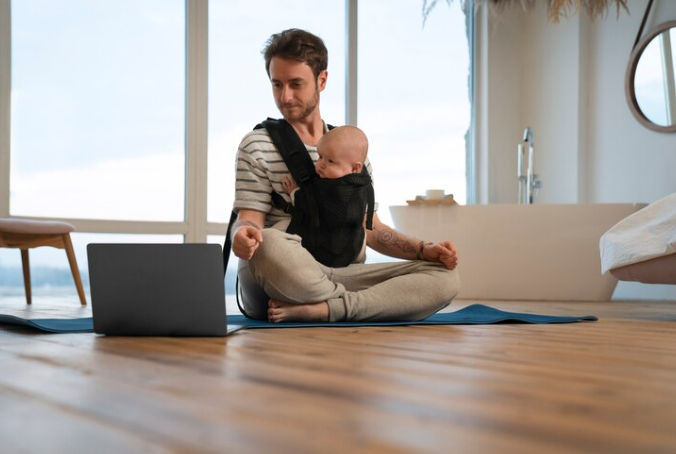
Here is the constraint nobody plans for. Your available training window drops to twenty or thirty unpredictable minutes, often inside a room where someone is sleeping.
Gym memberships die in that environment. Whatever you train with has to live in your house, set up in seconds and make noise nobody will hear two rooms away.
There is a second requirement people miss. The load needs to adjust downward on the weeks you are running on four hours of sleep, because sticking to your pre-baby numbers is how people get hurt.
Fixed weights make that awkward. A single heavy kettlebell is either the right load or the wrong one, and buying a full set of anything is not happening in a house that just absorbed a cot, a pram and roughly two hundred small plastic objects.
Storage decides most of it in the end. Gear that has to be dragged out and set up turns a workout into a decision, and decisions lose badly to exhaustion.
A water-filled bag handles both. Training with an aqua bag means you fill it from the tap to whatever weight suits the day, and it packs flat into a drawer when you are done.
It also happens to mimic the actual job. The water sloshes as you move, so your stabilizing muscles have to keep reacting rather than bracing against a fixed weight, which is a decent approximation of carrying a squirming kid.
The research supports the effect. Studies using water-filled training equipment have measured greater trunk muscle activation and better balance control during squats compared with a barbell, and one comparison found a water bag produced a stronger core stimulus than a barbell or sandbag of the same weight.
Build the sessions around what parenting demands. Loaded carries, deadlift patterns, single-arm presses and anything that trains you to hold a shifting weight away from your body without your spine rounding.
Two or three short sessions a week is enough to hold ground and slowly build. That matches the strength component in most activity guidelines, and it is realistic in a way that a five-day split is not.
A short plan for the year ahead
If you are still in the trying phase, get the semen analysis early rather than as a last resort. It is the fastest way to rule something in or out, and it stops your partner carrying the entire diagnostic burden alone.
If treatment is on the table, agree in advance on how many cycles you will do before reassessing. Deciding that while calm is far easier than deciding it after a negative test.
For the physical side, start training for the carrying now if there is still time. Grip, upper back and hips take months to build and about a week to appreciate.
Once the baby is here, protect the floor space more than the schedule. A corner of a room with something you can pick up for fifteen minutes beats a perfect program you never get to.
Conclusion
Fatherhood asks for two kinds of patience. One is the medical kind, where the timeline is not yours to set and the useful move is to get information early and act on it calmly.
The other is physical, and it rewards preparation in a very direct way. Being strong enough for the job means the job costs you less, and that leaves more of you for the part you actually signed up for.
Frequently Asked Questions
When should we see a fertility specialist?
After 12 months of trying without success, or after 6 months if your partner is 35 or older. Go sooner if either of you has a known reproductive health issue.
Does the man need testing even if he feels fine?
Yes. Sperm quality is not something you can feel, and male factor contributes in around half of cases, so skipping the semen analysis just delays the answer.
How many IUI cycles do people usually try?
Most specialists reassess after three or four unsuccessful cycles. Age and diagnosis both shift that number, and some couples are advised to move to IVF sooner.
Can I really build strength in 20-minute home sessions?
Yes, if you train with intent. Compound movements, a load heavy enough to be challenging and consistency across the week matter far more than session length.
Why train with an unstable load instead of dumbbells?
Both have a place. A shifting load asks more of your trunk and stabilizers, which maps closely onto carrying a child, while a fixed weight is better for tracking straightforward strength progress.
