

There’s No Such Thing as a Bad Year
Every January it shows up. The posts, the conversations, the feeling that the past year was “terrible.” Heading into the new year, 2025 was getting beaten up everywhere I looked. Part of this is a cognitive heuristic called the negativity bias. Our brains are wired to notice threats, losses, and problems more than neutral or positive events. While this bias kept us alive for millennia (remember the snake, survive the next encounter), the problem is that the same wiring now gets applied to modern life, where most of the “threats” are emails, comments, and annoyances. So, in our brain, the bad crowds out the good.
In any year, you can point to health scares, family stress, a job you don’t love, regrets, or things you wish you handled differently. That doesn’t make it a bad year. That’s just life. Viktor Frankl captured this perfectly in one of my favorite books of all time, Man’s Search for Meaning, when he wrote that between stimulus and response there is a space, and in that space lies our power to choose our response. That space is everything. It’s where meaning lives.
Life isn’t one long experience. It’s a string of moments. And while they feel automatically linked, you actually have some control over how much one moment affects the next. That’s metacognition and it’s a skill.
When a feeling hits hard, I use a simple Buddhist idea: sit next to the emotion and name it. “I am feeling angry,” not “I am angry.” Separate yourself from the feeling. That doesn’t mean ignoring it. Emotions matter. They motivate change. But, they shouldn’t run the show.
I also stopped doing the trendy year-in-review the usual way. Collapsing 365 days into a single label never made sense to me. Instead, every Christmas I write my kids a long letter about their year. It’s honest and includes the difficult parts of the year but also the highlights, their milestones, and what mattered to us as a family. This helps me plan out the next year, emphasizing what’s important.
(For 2026: more trips, more quality time with our parents, more connection with friends, and more activities and events for my kids to participate in.)
It’s peak-end theory playing out in everyday life. A week of a beautiful vacation can get erased by a delayed flight home if you let it. The same thing happens with years. What sticks isn’t the full story; it’s the ending and the emotional spikes. The good news is that you can shape both. The year wasn’t bad. The story you told about it just needs some better editing.
-Brian

🎙️ The Growth Kit (Podcast)

Full list of episodes here. Follow The Growth Kit on Instagram. Subscribe to your favorite podcast player (Spotify, Apple). And please leave a review!
🥇 Best of the Month
“Is that a dream or a goal? If it isn’t on the calendar, it isn’t real.”
—Brian Koppelman
🎧 Podcast: Dr. Emily Splichal: Foot Health is the Gateway to Improved Performance & Cognitive Function by The Ready State
📖 Book: The Status Game by Will Storr
🎁 Product: CookUnity; our new go-to meal service for delicious, healthy food
❓ Question of the Month
Q: What are the best ways to improve my VO₂ max?
A: VO₂ max reflects how much oxygen your body can use during hard exercise, and it is one of the strongest predictors of health and longevity we have. Large population studies show cardiorespiratory fitness is a stronger predictor of mortality than smoking, hypertension, or diabetes. Each 1 MET increase (about 3.5 ml/kg/min of VO₂ max) is associated with roughly a 10-15% reduction in all-cause mortality. People in the highest fitness categories have up to a 5x lower risk of death compared to those in the lowest.
The good news is that VO₂ max is highly trainable, even in midlife and later. Here are some workouts:
Classic 4 x 4: 4 minutes hard, 3 minutes easy, repeat 4 times. Frequency: 1-2 times per week.
Hill or incline repeats: 2-3 minutes uphill at hard effort, walk or easy jog down.
Total: 12 to 20 minutes of hard work.Bike or rower intervals: 6x2 minutes very hard, 2 minutes easy spin or row.
Zone 2 session: 45-75 minutes at a pace where you can speak in full sentences. Z2 does not directly increase VO₂ max. It builds the aerobic base that allows you to handle harder training and recover faster. Important, but not sufficient on its own.
⏱️ Brutal by Design
Each month, I share one brutally hard workout, something that challenges strength, grit, and capacity. These won’t be efficient or beginner-friendly. They’re designed to hurt.
Midwinter Grinder
Purpose: Build full-body strength, endurance and mental toughness during the lowest-motivation month
Equipment: Dumbbells or kettlebells and/or medicine ball, box or step, timer
Workout:
Format: 45 seconds work/15 seconds rest
Complete 4-5 total rounds of the circuit
Push-Ups
Step-Ups (alternate legs as needed)
Bent-Over Rows
Medicine Ball Slam (or DB/KB clean and press)
Rest: 2 minutes between rounds
Tip: Choose loads that feel manageable in round one but uncomfortable by round 3.
Optional Misery: Planks between sets.
💡 Things I’ve Learned
🧠 Mind
Can Saffron Match Antidepressants?
A new meta-analysis of 8 randomized controlled trials compared saffron directly with SSRIs in adults with depression and anxiety. The results showed no meaningful difference in symptom reduction for depression or anxiety, meaning saffron performed similarly to standard antidepressants. Where saffron stood out was safety. Participants taking saffron had 6% fewer adverse events, with consistent findings across studies.
This does not replace antidepressants, but it challenges the idea that pharmaceutical strength always equals better outcomes.
Do this: If SSRIs cause side effects or are poorly tolerated, ask your clinician whether a standardized saffron extract could be a monitored alternative.
Why We Think Now Is the Best Time of Life
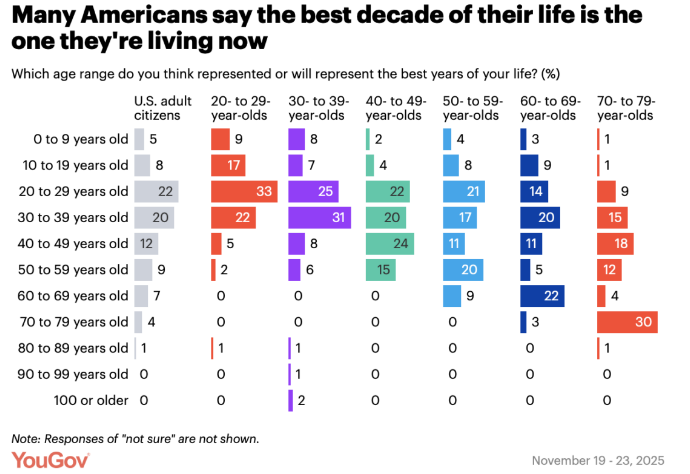
A recent survey shows a strong recency bias when people are asked which decade of life is best. Those in their 20s pick their 20s. People in their 30s pick their 30s, and so on. Even older adults tend to favor the present decade, with a secondary peak around three decades earlier. People in their 50s often choose their 20s. People in their 60s lean toward their 30s.
This pattern suggests we anchor happiness to familiarity, not objective quality of life.
Do this: Be skeptical when your brain tells you the “best years” are behind you. That belief may be bias, not truth.
Midlife Metabolic Health Matters More Than You Think
A massive Korean cohort study followed nearly 2 million adults aged 40-60 for almost 8 years and found a clear signal: metabolic syndrome in midlife was linked to a 24% higher risk of young-onset dementia before age 65. Risk increases were seen across dementia types, including a 12% higher risk of Alzheimer’s and a 21% higher risk of vascular dementia. The association was strongest in adults aged 40-49, women, people with obesity, depression, or regular alcohol intake, suggesting earlier metabolic stress may accelerate brain aging long before symptoms appear.
Do this: Aim to reverse even one metabolic risk factor at a time through strength training, daily movement, protein-forward meals, sleep consistency, and alcohol moderation.
💪 Body
The Walking Pattern That Slows Aging
Japanese researchers found that interval walking alternating fast and slow paces outperforms steady walking for preserving fitness with age. In middle aged and older adults, walking 3 minutes fast, 3 minutes slow for about 30 minutes led to greater gains in leg strength, aerobic capacity, and larger reductions in blood pressure than continuous moderate walking. Over 10 years, consistent interval walkers maintained 40% higher peak exercise capacity and 20% stronger legs compared with age matched controls.
Do this: Replace steady walks with interval walking 4 to 5 days per week. Push the fast intervals hard enough to breathe heavily.
A Reminder That “Food Safe” Is Not Guaranteed
Lead exposure is cumulative and often silent. The FDA’s expanded recall now includes multiple imported aluminum and brass products, with officials warning that more may be added. Even low dose exposure can impair learning, behavior, and neurologic function, particularly in children, while adults may see fatigue, headaches, or cognitive changes.
Do this: If you use inexpensive imported cookware, especially uncoated aluminum or brass, assume scrutiny is warranted and replace with safer alternatives.
Coffee Helps, Cream and Sugar Break the Effect
A large U.S. cohort study of 46,000 adults followed for over a decade found that coffee drinkers had lower all-cause mortality, with the strongest benefit in those drinking 1-3 cups per day. Risk reductions ranged from 15-17%. The protection, though, was limited to black coffee or coffee with very low sugar and saturated fat. Once sugar and cream were added, the mortality benefit disappeared.
Do this: There’s a lot of confusion around coffee. If you like it, get as close to you can to drinking it black to preserve the benefit.
🎯 Dad
Prenatal Vitamins and Autism Risk
An umbrella review covering 101 studies and over 3 million mother-child pairs found that prenatal folic acid or multivitamin use was associated with a 30% lower risk of autism spectrum disorder in offspring. The evidence was graded as highly suggestive, with consistent findings across multiple analyses.
Do this: If pregnant or planning pregnancy, follow evidence-based prenatal vitamin guidance and discuss folic acid dosing with a clinician.
10 Tips for Handling Devices and Screens
This is a great piece curated by Jon Haidt, featuring the work of Catherine Price, and it hit home for me as both a parent and someone who spends a lot of time thinking about mental health and my kids. The article breaks down the real harms of the phone-based childhood, but what I appreciated most is that it is not fear-based, but rather it provides practical suggestions.
My 3 favorites:
Tip 3. Only allow devices and screens (including the television) to be used in public places in your house.
Tip 5. Create a central charging station for devices (not in a bedroom)
Tip 9. Learn about and activate parental controls for every device and app your child uses
Children’s Mental Health and the Loss of Independence
Rates of anxiety, depression, and suicidality among children and adolescents have risen dramatically over the past several decades. Cross-temporal analyses show a one standard deviation increase in childhood anxiety between 1956 and the late 1980s, meaning roughly 85% of children were more anxious than the average child a generation earlier. By 2019, 36.7% of U.S. high school students reported persistent feelings of sadness or hopelessness.
Do this: Build age-appropriate independence into daily routines, including unsupervised play, independent errands, and problem-solving without adult intervention.
Like this newsletter? Check out previous monthly newsletters.
P.S. Help me bring health and happiness to more people--share this link with your friends and family so they can also learn awesome stuff.
