
October 2026

Underrated and Oversimplified: Health Literacy
The other day at work, I treated a 36-year-old patient whose blood pressure was 260/140. I was seeing him becuase he had already undergone multiple amputations following complications related to uncontrolled high blood pressure.
My next patient had a blood sugar of 327 and an A1c north of 10%. She told me that both of her parents had strokes and lost limbs because of complications from diabetes.
Shortly after that, a patient who had already lost both legs to uncontrolled diabetes was reluctant to share his food log with me (homework I gave him the week prior). He explained that we had “different philosophies about food.” He was a foodie and wasn't willing to give up cake or ice cream.
This was all in one afternoon.
After 16 years working in neurorehabilitation, I've seen countless variations of these stories. They're frustrating and mind-blowing, but more than anything, they're sad.
One side of my life is focused on optimizing my health, my family’s health, and helping readers do the same. I spend countless hours digging into research to figure out what moves the needle. Does organic coffee matter? How much protein do we really need? Should we train for strength or muscle growth? Does choline reduce dementia risk?
The other side of my life is helping people understand why high blood pressure is harmful, how diabetes damages blood vessels, or explaining that losing a limb to diabetes is often preventable and not genetic.
At the heart of both sides is the same thing: understanding how our daily choices influence our health and quality of life.
This is why health literacy matters so much. It’s a bit of a nebulous term given how complex “health” can be but it goes beyond simply knowing the facts. It’s understanding information, evaluating conflicting advice, making decisions, and applying what you've learned.
The first few parts of health literacy are becoming less hidden from view thanks to research, the internet, and AI, however, even when people receive good education, changing behavior is just really hard. There’s the behavioral psychology aspect of things such as cognitive dissonance, where people recognize the conflict between what they believe and how they behave, then rationalize their choices to reduce that discomfort (“My blood pressure is just high because I had a salty lunch.”). People become attached to their habits, identities, and ideas about health. Then just add in some layers of issues related to finances, access to care, insurance coverage, and the difficulty of changing long-established routines, and we have today’s labyrinth.
We're living in an interesting time when people are getting sicker but also living longer. Modern medicine can keep people alive through conditions that might have killed them decades ago, but living longer doesn't necessarily mean living healthier (see the case studies above).
So what do we do?
Start early. Have age-appropriate conversations with kids about the human body. Talk about the different colors of food, why sleep matters, how movement affects the brain, and how the choices we make today can influence how we feel tomorrow and decades from now. Make health a normal part of family conversations rather than something we only discuss when there's a problem.
Focus on the fundamentals. Though interesting (I’m guilty of this too), most people don't need to worry about the latest longevity supplement or whether cold exposure improves mitochondrial function. They need to understand the fundamentals.
Make health information practical. Knowing that exercise lowers blood pressure is useful. Understanding how to fit a 20-minute walk into your day, track your blood pressure at home, or build a routine you can maintain is far more actionable.
Stay curious and question what you think you know. Health information is constantly evolving (and despite the controversy of this, that’s a good thing; that’s called science). Learn to evaluate sources, ask questions, and recognize when a belief or habit might be worth reconsidering.
So as not to be a downer on this topic, the rest of that week was empowering. I worked with a determined woman recovering from cancer who asked (then immediately carried over) strategies to improve her poor bone density, someone who wants less shoulder pain when playing in the church band, a young guy who wanted to work on return-to-work skills post-tumor resection, and someone who just needs to pull up the right side of his pants so that he can decrease the burden of his wife doing it every time he uses the bathroom, and plenty of other examples of these.
Where your attention goes, grows. There’s a wide spectrum of health so continue to stay on the better part of that spectrum.
Brian
🏆 Stuff of the Month
🖋️ Articles
🎙️ The Growth Kit (Podcast)
Full list of episodes here. Subscribe to your favorite podcast player (Spotify, Apple).


🥇 Best of the Month
“My biggest fear isn't crashing this bike at 85mph and losing my skin. It's sitting in a chair at 90 and thinking, ‘I wish I'd done more.’”
—Graeme Obree (a Scottish professional cyclist, two-time world champion, and former world hour-record holder known as The Flying Scotsman)
🎧 Podcast: Eric Freitag: Concussions, Recovery, and the Action Plan You Need by The Ready State
📖 Book: Freakonomics (Revised) by Steven D. Levitt, Stephen J. Dubner, et al.
🎁 Product: Lumaflex Essential Pro red light therapy device
❓ Question of the Month
Q: What's the Best Way to Lose Fat Without Losing Muscle?
If you're trying to lose weight, you probably want most of that weight to come from fat, not muscle. Unfortunately, losing muscle is common when people cut calories, especially when they do it aggressively.
Here are eight things I recommend based on the research and my own experience.
Don't cut calories too aggressively. Start with a moderate deficit of around 300-500 calories per day. Aim to lose approximately 0.5-1% of your body weight weekly. A 2011 study found that athletes losing weight more slowly preserved more lean mass and had better strength outcomes than those losing weight faster.
Eat enough protein. I aim for roughly 0.7-1 gram of protein per pound of body weight daily, especially when trying to lose fat. A 2024 meta-analysis involving 47 studies and 3,218 participants found that higher protein intake helped preserve muscle mass during weight loss. Consuming less than approximately 0.45 grams per pound daily was associated with a greater risk of muscle loss. Protein also helps with fullness, making it easier to maintain a calorie deficit. I recommend a minimum of 0.8g/pound of desired body weight for active adults.
Keep lifting weights. Your muscles need a reason to stick around when you're losing weight. Aim for 2-4 strength training sessions weekly and try to maintain your strength. A 2025 meta-analysis found that resistance training during weight loss helped preserve fat-free mass and improve fat loss compared with dieting alone.
Get enough sleep. In a small 2010 study, participants sleeping 5.5 hours nightly lost approximately 55% less fat and 60% more fat-free mass than when sleeping 8.5 hours, despite similar total weight loss.
Walk more. Walking increases calorie expenditure without creating much additional fatigue. A brisk 30-minute walk can burn approximately 100-200 calories, depending on your size and pace.
Break up prolonged sitting. Even if you exercise regularly, sitting for hours limits your daily movement. Try getting up every 30-60 minutes for a few minutes of walking or other activity. Research suggests these short movement breaks can improve post-meal glucose and insulin responses.
Be mindful of carbohydrates. Carbs aren't inherently fattening, and they're important for exercise performance. Still, it's easy to overeat refined carbs from snacks, desserts, and sugary drinks. Prioritize protein, vegetables, fruit, and fiber-rich carbohydrates.
Don't overdo cardio. Running, cycling, and HIIT are great for cardiovascular health, but excessive training combined with a large calorie deficit can interfere with recovery. Keep strength training a priority and use cardio to complement it.
⏱️ Brutal by Design
Grindhouse
Purpose: I’ve been honing in on leg strength lately. Here’s a great one to build lower body strength with heavy, simple movements.
Workout (4 rounds):
Goblet squats: 15
Kettlebell swings: 25
Lunges: 10 per side
Farmer carry: 60 seconds
Optional Misery: Run afterwards
💡 Things I’ve Learned
🧠 Mind
Your Brain Can Learn to Notice More Good Things
Our attention naturally gravitates toward problems, threats, and unfinished tasks. Fortunately, we can also train ourselves to notice positive experiences. In a randomized study of 411 people, the Three Good Things exercise increased happiness and reduced depressive symptoms compared with a placebo exercise, with benefits still observed at six months among participants who continued practicing.
Do this: Each night for one week, write down (or at least think of) three things that went well and why they happened. Keep them specific. Even something as simple as an enjoyable conversation counts.
Could Choline Help Protect Against Dementia?
Choline doesn't get nearly as much attention as protein, fiber, or omega-3s, but it's essential for brain health. A recent meta-analysis of cohort studies found that moderate choline intake was associated with a lower risk of dementia compared with low intake. Interestingly, higher intakes didn't appear to offer additional protection. Choline helps produce acetylcholine, a neurotransmitter involved in memory and learning.
Do this: Aim for approximately 550 mg daily for men or 425 mg for women, the established adequate intake levels. Two large eggs provide roughly 300 mg of choline. Other good sources of choline include beef liver (356 mg), beef (117 mg), chicken breast (72 mg), salmon (75 mg), and roasted soybeans (107 mg).
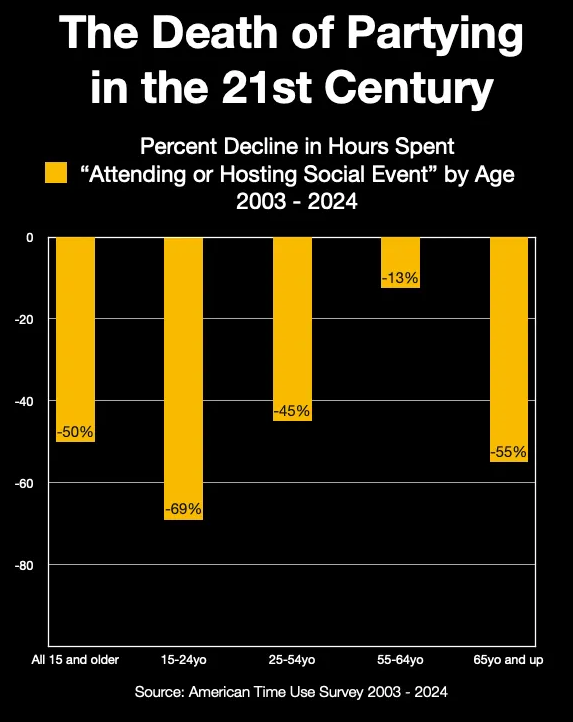
The 70% Collapse of Hosting
Scary but not so surprising: Americans are approximately 70% less likely to host friends or family monthly than they were 50 years ago. According to survey data highlighted by Derek Thompson, regular hosting declined from 42% in 1975 to 12% in 2026. COVID may have accelerated the shift toward staying home, and for many people, those habits stuck. Add in busier work and family schedules, shrinking friendships, and the endless entertainment available on our phones and TVs, and it's easy to see why getting together has become less common.
Do this: Start a recurring monthly dinner with friends. Rotate houses, keep the food simple, and put the next date on the calendar before everyone leaves.
💪 Body
Your Iron Levels Might Be Low Even If They're “Normal”
The American Society of Hematology released new guidelines in September 2026, raising the ferritin threshold used to diagnose iron deficiency. Ferritin measures your body's stored iron, and the previous cutoffs may have missed people with depleted iron stores.
Here's what changed:
Most adults: Increased from 15 to 30 ng/mL.
Young children (9 months to 4 years): Increased from 12 to 20 ng/mL.
Higher-risk groups: A threshold of 50 ng/mL may be appropriate, including people with heavy menstrual bleeding or anemia during pregnancy.
Adults with inflammation: Iron deficiency may be present with ferritin below 100 ng/mL or transferrin saturation below 20%.
Why the change? The old thresholds were too restrictive and could miss iron deficiency before anemia developed. The updated cutoffs aim to identify low iron stores earlier, particularly in people with symptoms or additional risk factors.
Do this: If you've experienced unexplained fatigue, weakness, or declining exercise performance, consider asking your healthcare provider about ferritin testing. Even if your previous results were labeled normal, they may warrant another look under the updated guidelines. Don't start iron supplements without confirming a need.
6 Nutrition Myths Worth Rethinking
A 2026 scientific review examined common nutrition claims, including several that continue to influence how people eat and exercise. There need to be more reviews like this. Here is the TLDR:
Do you need to bulk to build muscle? No. Beginners and intermediate lifters can often gain muscle while losing fat.
Does eating late make you gain fat? Not automatically. Total calorie intake matters more than an arbitrary cutoff time, although meal timing can influence appetite and metabolism.
Are carbs more fattening than fat? Not inherently. When calories and protein are matched, neither has a clear advantage for fat loss.
Do you need to eat protein immediately after exercising? No. Total daily protein intake matters more than hitting a narrow post-workout window.
Are frequent small meals better for metabolism? No. Eating six meals instead of three doesn't meaningfully increase daily calorie expenditure when total intake is equal.
Is intermittent fasting better than traditional dieting? Not necessarily. When calorie intake is comparable, weight-loss results are generally similar.
Your Body Responds to Inactivity Faster Than You Think
Two fascinating studies, published 25 years apart, illustrate the effects of inactivity and exercise. A 2026 study found that just 10 days of bed rest reduced mitochondrial mass and increased oxidative stress in older adults. Meanwhile, a 30-year follow-up of the Dallas Bed Rest Study found that six months of endurance training reversed the age-related decline in aerobic capacity observed in five men. Although both studies were small, they highlight how responsive our bodies are to movement and inactivity.
Do this: I see this on a daily basis at work. Even a few days in a hospital (or home) bed can crush your health. It will likely happen to all of us for varying degrees of time, so make sure you’re fit enough going into any bed rest and get back to movement afterwards as fast as you can.
🎯 Dad
Roughhousing With Dad Is Good for Kids
Wrestling on the floor, chasing each other around the house, or having a pillow fight is more than fun; it’s purposeful. A meta-analysis of 16 studies involving 1,521 father-child pairs found associations between physical play and children's social skills, emotional regulation, and behavior. The findings were mixed, though, and how dads played mattered. Play that becomes overly aggressive or ignores a child's boundaries may have the opposite effect.
Do this: Just get on the floor with kids. They’ll find a way to make it interesting, fun, and eventually rough. Teach boundaries, establish a stop signal, and tell mom there are benefits to this.
The Selfish Side of Parenting
We hear plenty about how expensive, exhausting, and demanding parenting is. All true. But Kevin Kelly makes an interesting case for the personal benefits of having children. One of my favorites is simply getting to watch them experience the world. Their questions, creativity, humor, and excitement over ordinary things are things you can't really replicate anywhere else. Here’s one:
“A primeval and foundational need of all humans everywhere is to belong, and to be loved. For at least the first decade of their lives, your children will love you to a degree adults do not experience otherwise. This unconditional love is so potent, that humans will often surrender their own lives to maintain and culture it. It is so potent, it can change lives, change the behavior and even world views of parents. The joy of being loved, admired, and needed to such a degree is unmatched in the rest of our lives.”
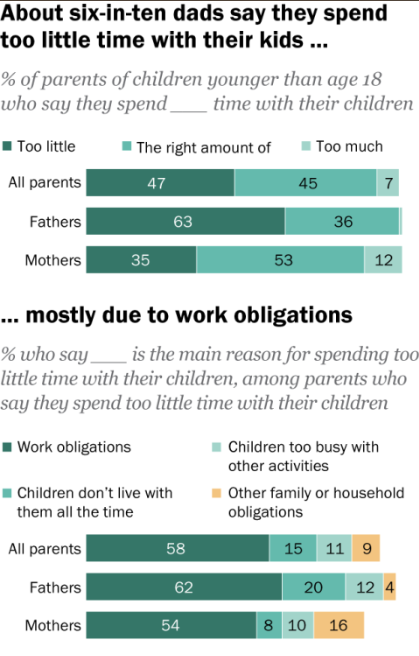
The Parenting Time Gap
About 63% of dads felt they spent too little time with their children, compared with 35% of moms. That's a 28-percentage-point difference. And among parents who wanted more time, work was the most frequently reported obstacle. These findings are from 2017, but they raise a question that's still relevant: How much of our limited time are we spending on things that actually matter to us?
Like this newsletter? Check out previous ones.
P.S. Help me bring health and happiness to more people--share this link with your friends and family so they can also learn awesome stuff.
