
September 2026

Why We Think We’re Better Than Average
A couple of months ago, I wrote about why being average is a terrible idea. That’s all fine and dandy logically speaking when you look at the data; however, the main factor that actually nudges us closer to that poor benchmark is that most of us don’t think we’re average in the first place.
I’ve been listening to David Brooks’ great book, The Social Animal, and one section describes the mind as something of an “overconfidence machine.” Here are some examples he gave:
90% of drivers believe they’re above average behind the wheel.
94% of college professors think they’re above average teachers.
90% of entrepreneurs believe their new business will succeed.
98% of students taking the SAT rated themselves as average or above average in leadership ability.
PGA golfers estimated they would make about 70% of six-foot putts, while the actual success rate was closer to 54%.
In one study, half of students predicted they would confront a sexist comment, but when researchers created the situation, only 16% actually did.
The pattern goes beyond simply thinking we’re better than average.
We overestimate our willpower. We assume we’ll exercise, eat better, save money, or follow through later. As every self help book will tell yuo and every successful leader endorses, make the surroundings work for you. Build habits, routines, and environment that make good behaviors easier rather than relying on motivation.
We overestimate what we know. Confidence can increase much faster than competence. Personally, the more I learn, the less I know. This goes for health, OT, parenting, business, and training. More answers are “I’m not sure” and “Maybe” than black-and-white ones.
Success makes us more confident. A few good investments, workouts, business decisions, or self-experiments can convince us that we figured something out when luck may deserve some (or none) of the credit.
We’re good at explaining ourselves after the fact. I do a lot of self-experimentation with exercise, nutrition, supplements, recovery, and other health strategies. It’s easy to try something, feel better, and create a convincing story about why it worked. Cognitive dissonance, confirmation bias, and post hoc rationalization can all push us in that direction.
We think our future selves will behave better than our current selves. I see this in health care, parenting, and my own life. Knowing what I should do at 6:00 AM is different from actually doing it when I’m tired, stressed, busy, or frustrated.
I’m not saying confidence is bad. It’s great and useful but we need to reality check it. Here are some questions to ask yourself periodically:
What would actually make me change my mind?
Was that a good decision, or did it just happen to work out?
Am I expecting more discipline from my future self than I usually have today?
I’m 50% sure this is the right approach,
Brian
🏆 Stuff of the Month
🖋️ Articles
🎙️ The Growth Kit (Podcast)
Full list of episodes here. Subscribe to your favorite podcast player (Spotify, Apple).


🥇 Best of the Month
“It is far better for a man to go wrong in freedom than to go right in chains.”
— Thomas H. Huxley
🎧 Podcast: You can't be too happy, literally by Experimental History
📖 Book: Shift by Ethan Kross
🎁 Product: Alen Air Purifiers. An air purifier is one of those things you barely notice until you really need it.
❓ Question of the Month
Q: What’s the best way to recover after a tough workout?
When it comes down to it, recovery is mostly about getting the basics right. There are plenty of tools and products that promise to help you recover faster, but the main goal is simply to give your body what it needs to repair muscle tissue, replenish glycogen, replace fluids, and be ready for the next training session. Protein, carbohydrates, hydration, and sleep do most of the work.
Shift into parasympathetic mode: After a hard workout, spend 5-10 minutes lying on your back and breathing slowly. Try 4 seconds in and 6-8 seconds out. Extending the exhale can help bring your heart rate down and shift your nervous system away from the high arousal state of training.
Protein: Aim for roughly 30-40 grams of high-quality protein after training to give your body the amino acids needed for muscle repair and adaptation. Don’t stress about rushing to get it down immediately. The so-called anabolic window is much wider than most people think, and your total daily protein intake matters more.
Carbohydrates: Carbs help replenish the muscle glycogen you burned during training. They become especially important after long or intense workouts and when you plan to train again within several hours. If you have a full day before your next workout, there is usually much less urgency.
Hydration: Replace the water and electrolytes you lost through sweat. A useful target after substantial fluid loss is roughly 125-150% of the fluid you lost, since you’ll continue losing some water through urine after exercise. For especially sweaty workouts, sodium matters too.
Sleep: Prioritize a full night of quality sleep. Sleep supports muscle repair, hormone regulation, nervous system recovery, and the adaptations you are actually training for. A recovery gadget isn’t going to compensate for consistently getting 5 hours of sleep.
Light movement: Walking, easy cycling, mobility work, or another form of active recovery can help you feel less stiff and keep you moving without adding much additional training stress. Keep the intensity low enough that it actually feels restorative.
Recovery tools: Sauna, cold exposure, compression, massage, IASTM, and similar strategies can be useful, but I view them as additions to the basics above. Cold water immersion can reduce soreness and help short term recovery, but repeatedly plunging immediately after resistance training may interfere with some of the signaling involved in strength and muscle growth. If you use cold right after training, keep the exposure brief or, better yet, save longer cold sessions for later in the day. For more options, see my 11 Best Workout Recovery Strategies.
⏱️ Brutal by Design
Track Pyramid
Purpose: It’s Turkey Trot training time. Find a track and hit it hard to improve the engine.
Workout (4 rounds):
Run 1 mile easy
2 x 800m hard
3 x 400m hard
4 x 200m fast
Run 1 mile easy
Optional Misery: Finish with 4 x 100 m sprints.
💡 Things I’ve Learned
🧠 Mind
91% of Worries Never Happened
Researchers followed adults with generalized anxiety disorder as they recorded worries in daily life and tracked whether those feared outcomes actually occurred. 91.4% of worries did not come true, and the most common individual result was 100% of worries being untrue. Even more interesting, people with a higher percentage of untrue worries experienced greater reductions in GAD symptoms during therapy, suggesting that paying attention to how often worries are wrong may itself help reduce anxiety.
Do this: Keep a simple worry log for a week. Write down what you’re afraid will happen, then come back later and record what actually happened. For bigger decisions, add a note to your calendar 9 months from now and check in with yourself. You may find that the thing consuming your attention today barely registers by then, or you may not even remember why you were so worried about it.
7,500 Steps May Be Enough to Help Protect Your Brain
A 2025 Nature Medicine study followed cognitively healthy older adults and found that among people with elevated brain amyloid, higher daily step counts were associated with slower tau accumulation and slower cognitive and functional decline. Interestingly, the benefits appeared to level off around 5,001-7,500 steps per day, suggesting you may not need 10,000 steps to see meaningful associations with brain health.
Do this: Aim for at least 5,000-7,500 steps per day, especially as you get older. If you are currently sedentary, simply adding a daily walk may get you much closer to the range associated with slower Alzheimer’s related changes.
Could Zinc Help Protect the Aging Brain?
Researchers followed nearly half a million adults aged 40-71 and found that zinc supplement users had a lower incidence of dementia over a median of 11.9 years. Zinc use was associated with about a 16% lower risk of all-cause dementia and a 29% lower risk of Alzheimer’s disease, while vitamin C, vitamin E, and selenium supplements showed no significant association. The relationship between zinc and dementia was particularly strong among participants with cataracts.
Do this: Prioritize zinc-rich foods such as oysters, lean red meat, pumpkin seeds, and legumes. If you supplement, avoid assuming more is better since chronically high zinc intake can interfere with copper absorption.
💪 Body
Your Plaque Burden May Matter More Than Your Risk Score
A 2026 study followed 6,061 symptomatic patients who underwent coronary CT angiography and used AI to quantify plaque throughout the coronary arteries. Cardiovascular risk rose sharply as plaque volume increased. Compared with people with no measurable plaque, those with 250–750 mm³ of total plaque had about a 10-fold higher hazard of a major cardiovascular event, while those with more than 750 mm³ had nearly a 16-fold higher hazard. Risk increased significantly starting around 250 mm³, and the pattern was consistent across different clinical risk groups.
Do this: Keep focusing on the basics that slow atherosclerosis over time: control blood pressure, exercise, don’t smoke, manage blood sugar, and know your cholesterol numbers.
Running Doesn’t Appear to Wear Out Your Discs
The idea that running repeatedly pounds the spine and accelerates disc degeneration doesn’t hold up very well in the current research. In a systematic review of 4,152 participants, running was actually associated with better intervertebral disc health, while most other forms of physical loading showed no clear positive or negative association.
Do this: Think of your spine as tissue that adapts to appropriate loading. Running, strength training, and regular movement can all be part of a healthy back when progressed gradually and performed within your tolerance.
You Can Lower Plastic Exposure in Just One Week
A 2026 randomized controlled trial tested whether reducing everyday plastic contact could actually lower plastic-associated chemicals in the body. After just 7 days, participants following a low plastic diet had urinary levels of several chemicals drop substantially, including BPA by 59.7%, monobenzyl phthalate by 53.5%, and mono-n-butyl phthalate by 37.5%. The biggest effects came from foods that had minimal contact with plastic from production through preparation.
Do this: Focus first on food contact. Use glass or stainless steel when practical, avoid heating food in plastic, and cut back on highly processed, heavily packaged, and canned foods.
🎯 Dad
Working From Home May Influence Family Size
Economists studying remote work and fertility found that both actual births and planned fertility were higher among people who worked from home at least one day per week. The association was strongest when both partners had remote work flexibility, with estimated lifetime fertility about 0.32 children higher per woman compared with couples where neither partner worked from home.
Do this: When evaluating a job, consider flexibility as part of the compensation package. Remote or hybrid work may affect family life in ways that go beyond convenience, including how manageable parenting and future children feel.
Kids Are Becoming More Afraid to Get Things Wrong
A large meta-analysis found that perfectionism has increased across generations of young adults, based on nearly 83,000 students from 307 studies. One of the strongest increases was in concern over mistakes and fear of negative judgment. Those pressures matter because perfectionism has been linked with higher levels of anxiety and depression.
Do this: Normalize mistakes at home. When something goes wrong, focus on what your child learned, what they can try differently, and whether they were willing to take a chance in the first place. We use this phrase often in our house: “Something is going to go wrong….and that’s okay.”
Moms and Dads May Invest Differently in Their Kids
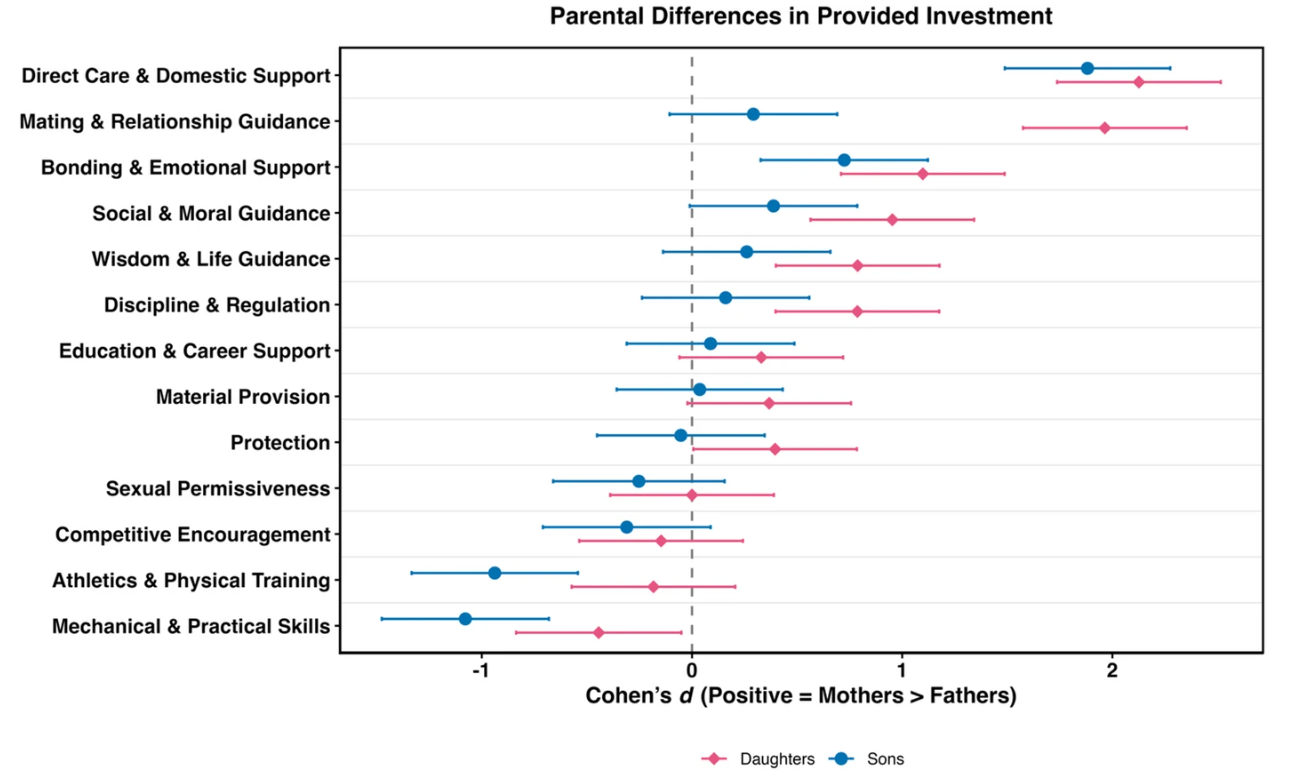
A recent study found that mothers and fathers appeared to emphasize different areas of parenting. Mothers were reported to provide more direct care, bonding, moral and social guidance, and discipline. Fathers provided more investment in athletics, mechanical skills, and practical skills, with much of that additional investment directed toward sons.
The researchers suggest these patterns may partly reflect long-standing sex differences in parental roles and offspring needs, although social expectations likely play a role as well.
Do this: Look at the skills you naturally teach your kids and the ones you leave to your spouse. Kids benefit when both parents broaden the range of experiences and guidance they provide.
Like this newsletter? Check out previous ones.
P.S. Help me bring health and happiness to more people--share this link with your friends and family so they can also learn awesome stuff.
