
The 100 Minus Your Age Challenge: A Birthday Fitness Tradition
“Discipline is remembering what you want.”
--David Campbell
For my 40th birthday, I want something different than cake or a dinner out; I want a test. Something that demanded strength, endurance, power, and grit; four of the pillars of real fitness. But I also want a tradition, a ritual I could do at every birthday from here on out. I want to make it meaningful, scalable, and repeatable. One way of looking at it is that my current self is challenging my future self year-after-year.
At first, I thought one pound, minute, rep, etc. for every year of age, but I quickly realized this model would age poorly (doing 80 push-ups at 80?!). So I flipped the script. It’s not perfect but it’s personal so modify it how you see fit.
Celebrate strong.
The Birthday Fitness Challenge
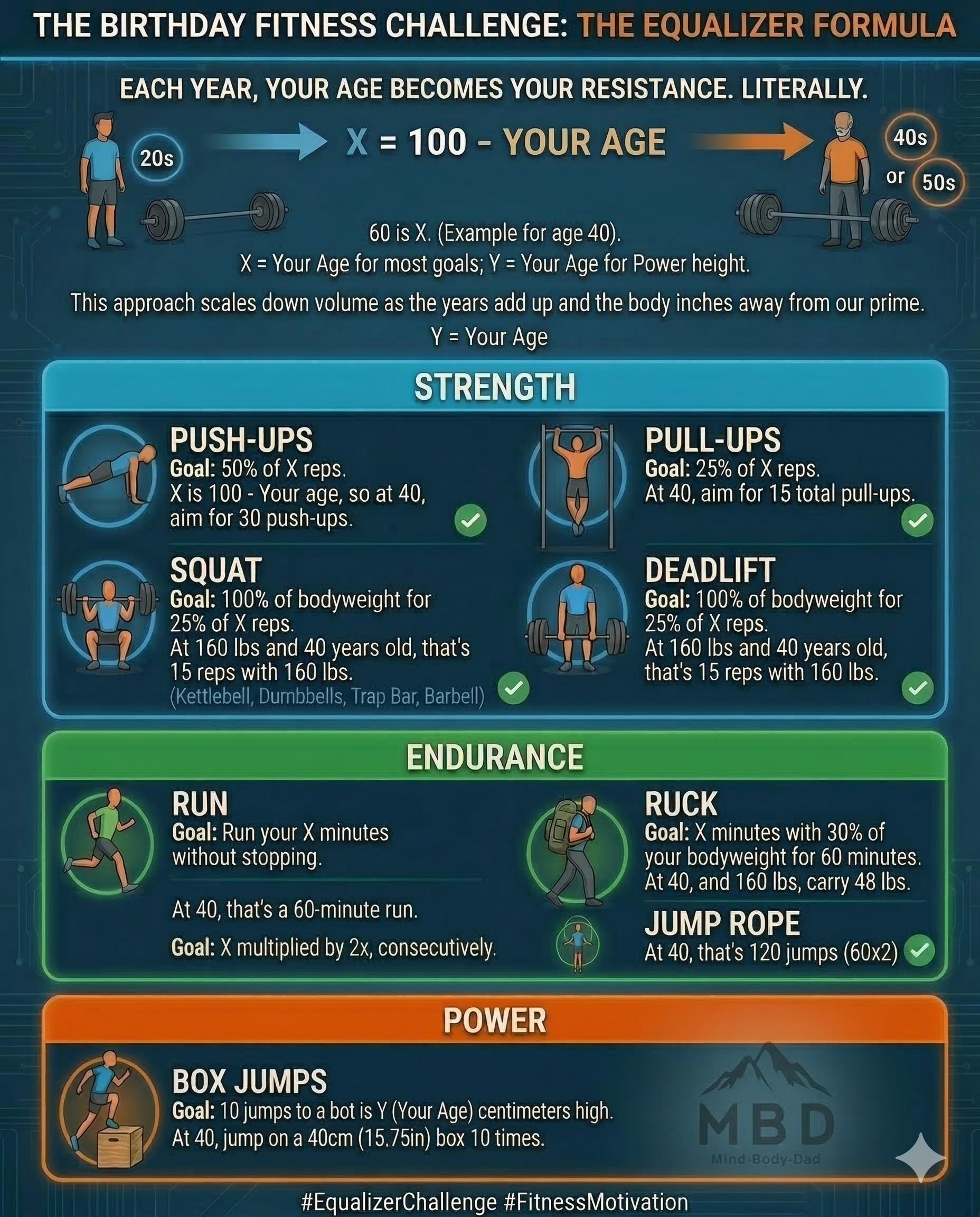
The Equalizer Formula
Each year, your age becomes your resistance. Literally. Here’s the simple formula:
X = 100 – Your Age (e.g. 100 - 40 years old = 60. 60 is X.)
Y = Your Age
This approach scales down volume as the years add up and the body inches away from our prime.
The Fitness Challenges
Strength
✅ Push-Ups
Goal: 50% of X reps.
Example: X is 100 - Your age, so at 40, aim for 30 push-ups.
✅ Pull-Ups
Goal: 25% of X reps.
Example: At 40, aim for 15 total pull-ups.
✅ Squat
Goal: 100% of bodyweight for 25% of X reps.
Example: At 160 lbs and 40 years old, that’s 15 reps with 160 lbs.
You can use a kettlebell, dumbbells, a trap bar, or a barbell—whatever setup keeps your form tight and your knees tracking well.
✅ Deadlift
Goal: 100% of bodyweight for 25% of X reps.
Example: At 160 lbs and 40 years old, that’s 15 reps with 160 lbs.
Endurance
✅ Run
Goal: Run your X minutes without stopping.
Example: At 40, that’s a 60-minute run.
✅ Ruck
Goal: X minutes with 30% of your bodyweight for 60 minutes.
Example: At 40 and 160 lbs, carry 48 lbs for 60 minutes.
✅ Jump Rope
Goal: X multiplied by 2 jumps, consecutively.
Example: At 40, that’s 120 jumps (60x2).
Power
✅ Box Jumps
Goal: 10 jumps to a box that is X centimeters high.
Example: At 40, jump on a 40cm (15.75in) box 10 times.
Cheat Sheet
Equalizer Formula
X = 100 − Age
Y = Age
Challenges
Push Ups = .50X
Pull Ups = 0.25X
Squat = 0.25X reps at 1× bodyweight
Deadlift = 0.25X reps at 1× bodyweight
Run = X minutes
Ruck = X minutes with 0.30 × Bodyweight
Jump Rope = 2X jumps
Box Jumps = 10 jumps to a Y cm box
How to Make It Stick
1. Do it within 3 days of your birthday. Life happens but commit to a tight window and make it a tradition.
2. Schedule it yearly as a calendar event. Add it with a recurring event in your calendar.
3. Invite others. Make it social. Get your kids involved. Or challenge a friend your same age.
FAQ
Q: What if I’m over 99 years old?
A: First of all, congratulations. If you are still testing your fitness at 100, you are officially winning. At that point, feel free to flip the formula to X = your age or simply choose a version of the challenge that keeps you moving safely. The real goal of this tradition is longevity, consistency, and a reason to celebrate what your body can still do each year. If you are doing push-ups and box jumps at 100, the rest of us are just trying to keep up.
Q: Do I have to complete everything in one workout?
A: No, you can spread it out over a few days or even a week.
Q: Can women do this challenge?
A: Absolutely. The formula works for anyone. Women may choose to adjust certain movements depending on strength levels or training background. For example, many women will use band-assisted pull-ups or lighter loads for the squat and deadlift. The goal is still the same: a meaningful yearly fitness test.
Q: What if I cannot do any of the workouts yet?
A: Start with beginner-friendly variations that train the same movement patterns. The goal is participation, then progress, year-over-year.
Examples of modifications:
Push-ups: Wall push-ups or incline push-ups on a countertop or bench
Pull-ups: Resistance band rows, TRX rows, or seated cable rows
Squat: Chair sit to stands or goblet squats with a light weight
Deadlift: Kettlebell deadlifts, Romanian deadlifts with light dumbbells, or hip hinges
Run: Brisk walking, cycling, elliptical, or swimming
Ruck: Walking with a light backpack or simply walking without weight
Jump rope: Marching in place, step hops, or low-impact jumping jacks
Box jumps: Step ups onto a low box or sturdy step
Even doing a simplified version of each movement still creates a meaningful yearly fitness test.
Q: Why use the “100 minus your age” formula?
A: It keeps the challenge demanding but realistic over time. Volume gradually decreases as you age, allowing the tradition to continue for decades.
Q: Can I do more than the minimum challenge?
A: Of course. The numbers are meant to be a baseline, not a limit. Go above and beyond. Go ahead and exceed the targets, add weight, tack on another set, or throw in a few extra challenges. Just keep it balanced. The whole point of this tradition is doing it year after year, and staying balanced between the different areas. Think of the formula as the minimum standard that keeps you honest.
Q: What should I track?
A: Record your results, notes, and observations. Over time you will see patterns in strength, endurance, and recovery. That is where the real value of the tradition appears.
Q: Can I add other challenges or swap movements?
A: Definitely. In fact, there were many more I wanted to add to this challenge, but I kept it simple. Feel free to customize it based on your interests or strengths. Some people like to add additional tests each year or rotate movements.
Examples you could include:
Dead hang: Hang from a pull-up bar for X seconds
Farmer carry: Walk carrying heavy dumbbells or kettlebells for X meters
Hiking distance: Hike X kilometers or X thousand steps
Plank hold: Hold a plank for X seconds
Sled push or pull: Push a sled for X meters
Bike ride: Ride X minutes or X kilometers
Grip strength: Max dead hang or farmer carry time
Related:
